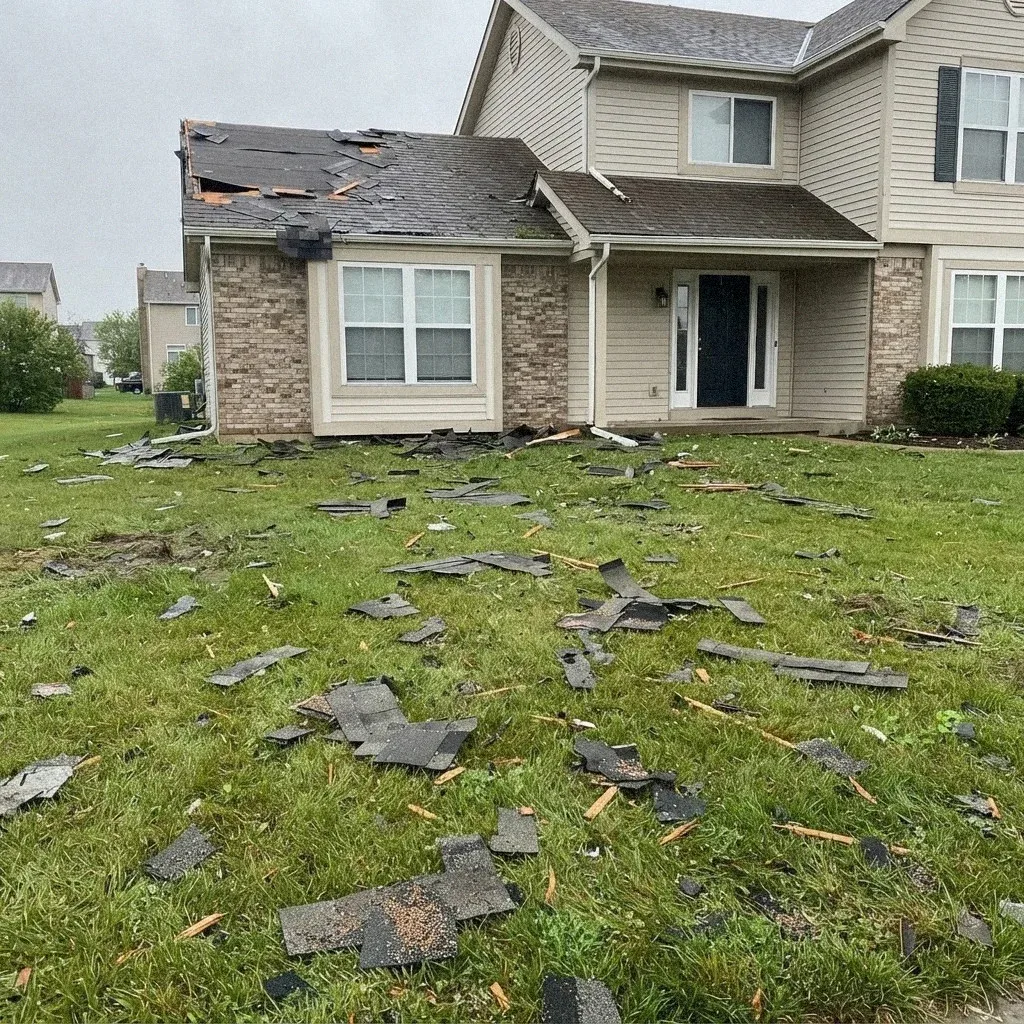
Roof Repair After Jacksonville Wind and Storms
Fast inspection and repair after wind, hail, or a fallen limb.
Storm & Wind Damage Roof Repair in Jacksonville, FL is not one job with one price, whether you're in San Jose, Argyle Forest, Mandarin, or elsewhere around Jacksonville, and the work is matched to the building and to the way water actually moves through it here. That is what separates a lasting repair from a temporary one.
This is most often a home job — residential roofing sets out what that involves, or see commercial roofing if the property is a business or a rental.
Signs You May Need Storm & Wind Damage Roof Repair
How Wind and Hail Break a Roof
Walk the property first, before calling anyone. Wind uplift after a Jacksonville thunderstorm or tropical system tends to show up as blown-off shingles scattered across the lawn or wedged in a fence line near Arlington and Northside blocks alike. Creased shingles are the trickier sign — they fold instead of tear and can lie flat again once the wind drops, so lifted tabs along a ridge or eave are worth a closer look even when nothing looks torn off.
What Shows Up From the Driveway
Fallen limbs are the other common damage source, especially on older lots in Avondale, Ortega, and San Marco where tree canopy sits close to the roofline. A limb strike can crack a shingle mat, punch through decking, or tear flashing loose without leaving an obvious hole from below. If a limb is still resting on the slope, the roof is carrying weight it wasn't built for, and that's not something to check by climbing up yourself.
What the Inspection Turns Up
Closer to the roof, a pro looks for granule loss around vents and skylight curbs, hail bruising where the shingle mat has gone soft, and punctures near where a limb landed. Ridge caps get checked for lifted or missing sections, since that's often where wind gets a first grip. None of this needs to be visible from the driveway to matter — it's the difference between a dry attic and a slow leak after the next Duval County storm.
Our Storm & Wind Damage Roof Repair Process
Your Call to Report Storm Damage
A conversation about what you saw fall, felt, or heard, and where on the roof it happened. That detail decides whether this gets looked at today or fits into tomorrow's schedule.
Full Roof Inspection in Jacksonville
An on-site storm inspection covering every slope, not just the one facing the street, checking ridges, valleys, flashing, and any spot near a fallen limb for punctures or torn seams.
Debris Cleared, Damage Photographed
Limbs and granule buildup get cleared off the roof and out of the gutters, then every affected section, from lifted tabs to a cracked ridge cap, gets photographed as the storm left it.
Repairing What the Storm Hit
The fix targets what the storm actually did, whether that's replacing a run of blown-off shingles, resealing a torn flashing joint, or patching a deck punctured by a fallen limb.
Why this matters
Jacksonville sits in an active hurricane corridor, and Florida Building Code sets design wind speeds locally around 125 to 130 mph depending on which side of the demarcation line a house falls on. Older homes across Springfield, Murray Hill, and similar neighborhoods weren't always built or re-roofed to that standard, so wind uplift finds the weak seam first — usually at a ridge, valley, or flashing edge, not the open field of the roof.
Code-Compliant Storm & Wind Damage Roof Repair in Florida
Clearing Debris Before Anything Else
Debris removal comes before anything else once a storm passes, whether it's a scattering of shingles off a Westside roof or a limb down near Fishweir Creek. The roof doesn't have to look broken from the street to be compromised — a shingle that lifted and settled back into place can still have a broken seal underneath, and that's the part a ground-level look misses entirely.
Photos Before Any Repair Starts
Photo documentation happens before any repair changes what the storm left behind. That record notes the date, wide shots of the whole roof, and close shots of anything torn, punctured, or missing — separate from whatever an insurance claim later needs, and separate from putting up a tarp. Skipping this step is the thing Jacksonville homeowners usually regret once repairs are already underway.
How Much Does Storm & Wind Damage Roof Repair Cost in Jacksonville?
These are the figures quoted most often for storm & wind damage roof repair. The size of the roof, its pitch, and how easy it is to get a ladder to move the number.
| State License | Insurance Proof | Payment Structure |
|---|---|---|
| Scope in writing means the roof described in enough detail that you could hold the finished job against it: which areas, which product line by name, what flashing is being replaced rather than reused, and what the ventilation plan is. The phrase reroof house is not a scope. | Full walk of the roof plus flashing and vent boots checked by hand | an estimated $630–$7125 |
| Ask for signed lien releases from every supplier and sub involved in the job, not only the main contractor, before final payment goes out. Larger commercial jobs treat this as routine; a homeowner's reroof deserves the same habit. | Tear-off with upgraded underlayment for wind resistance, no chimney or skylight work | an estimated $900–$9750 |
| Two warranties come with a reroof and they cover different things. The manufacturer's covers the material if it was defective; the contractor's covers the installation if it was wrong. Ask how long the second one runs, get it in writing, and remember it is only worth as much as the company behind it. | Tear-off across a larger footprint, decking replaced by the section, valleys rebuilt | an estimated $1170–$13500 |
| The permit record outlives the roof. A Jacksonville reroof pulled under the contractor's license and signed off at final inspection leaves a clean public record that a buyer's inspector, a lender, or a storm adjuster can look up years later. One never closed shows up as an open item at the worst moment. | Full tear-off and disposal, new gutters sized to the roof, downspouts reset | an estimated $1620–$19500 |
A permit isn't paperwork for its own sake; it puts an inspector's eyes on the work before it's covered up. Skip it and any defect stays hidden until a sale or a claim forces the question, usually at your expense.
Frequently Asked Questions
How soon should a storm-damaged roof be inspected?
As soon as you notice it, ideally same-day. Jacksonville's afternoon thunderstorms and hurricane-season squalls off the St. Johns River area don't wait, and a lifted tab or exposed spot near a valley turns into a soaked ceiling fast. If you already see granules in the gutters or a limb came down, call before the next round of rain arrives.
How do I know if wind actually damaged my roof?
Sometimes, but not always. Shingles in the grass, tabs standing up instead of lying flat, or bare patches where granules washed off are visible signs. Wind damage is also a broken seal you can't see from the ground, so a roof that looks untouched after a storm can still have lifted tabs waiting to fail in the next one.
A tree limb fell on my roof — what should I do?
Get everyone clear of the area first and stay off the roof yourself. A limb resting on a slope is putting weight on framing that wasn't built to carry it, and walking near it to look closer risks a section giving way. Call for an inspection instead of climbing up, especially if the limb is large or the roof pitch is steep.
Why do you photograph damage before repairing anything?
Because a repair changes the roof before anyone has a record of what the storm actually did to it. If a dispute ever comes up about what's storm-related versus older wear, the photos taken beforehand are what settle it. Once a shingle is replaced or a tarp goes up, that specific evidence is gone for good.
Does one small crease from wind mean a bigger repair later?
It can. Even a small gap, like one creased shingle or a strip of torn flashing near a chimney, gives water a path into the deck. Jacksonville's humidity keeps wet wood from drying out between storms, so what starts as a minor puncture after a fallen limb can turn into a stained ceiling or soft spot within a week or two if it sits unaddressed.
Is it wind or hail that usually causes the damage?
Both, and flashing is often the bigger factor. Wind gets under metal at a chimney, wall, or valley and lifts it just enough to open a path for water, while hail can bruise or dent softer flashing without tearing it outright. A storm inspection checks both, not just the shingle field most people notice first.
How much does storm & wind damage roof repair cost in Jacksonville?
Jacksonville roofs tend to give out gradually rather than in one dramatic blowup. Sandy soil settling, afternoon thunderstorms finding a weak spot, sun beating on shingles year after year — the damage stacks up quietly until a small leak turns into a soggy ceiling.
Related Services & Areas
Ready To Get This Handled
One call is enough to start. Say what the roof is doing and roughly when it started, and the licensed pros we connect you with will tell you whether it needs looking at this week or can wait for the next dry stretch. If something is actively coming through a ceiling in Jacksonville, say so on the call, because that moves to the front of the list and gets covered the same day rather than scheduled.
Call (904) 675-6349