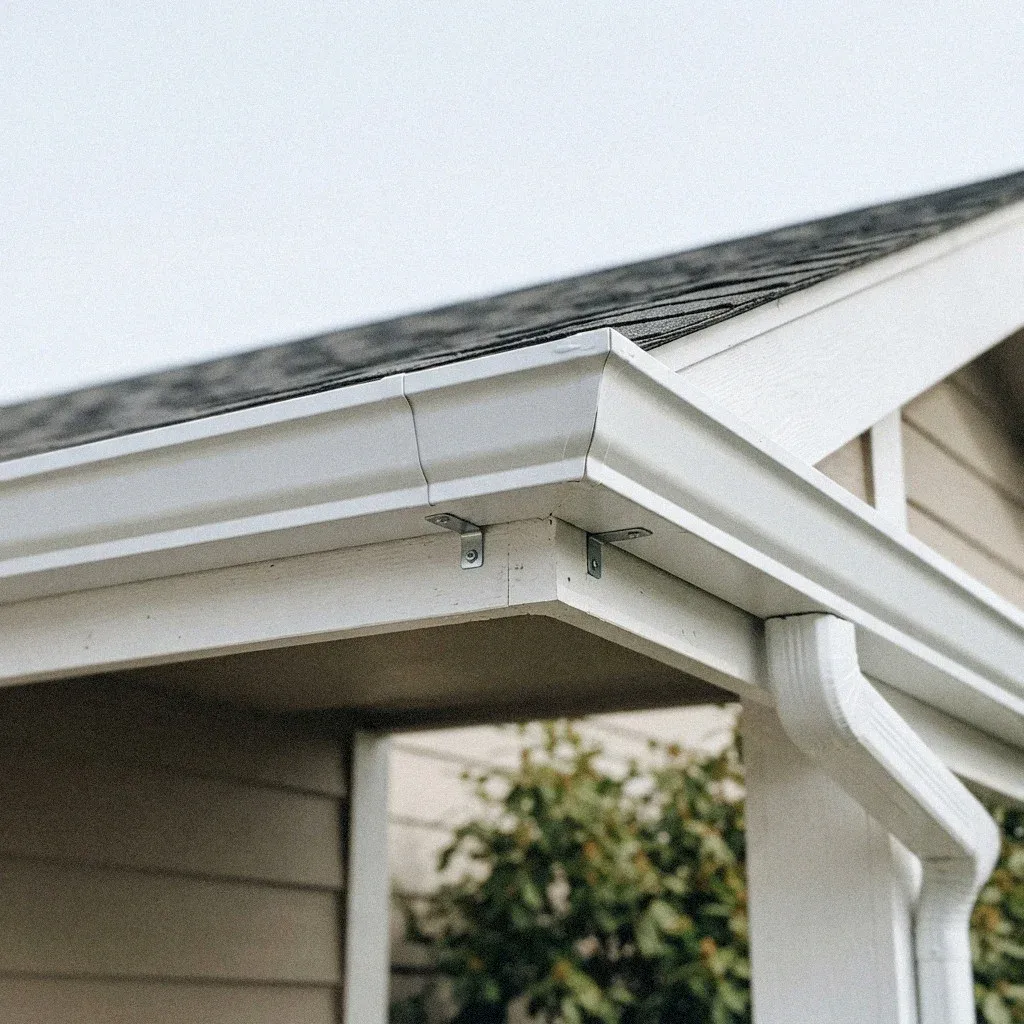
When a Gutter Run Needs Rehanging, Not Replacing
Rehung where it holds, replaced where fascia has already given way.
Gutter Repair & Replacement in Jacksonville, FL is not one job with one price, whether you're in Atlantic Beach, Neptune Beach, Ponte Vedra Beach, or elsewhere around Jacksonville, and the work is matched to the building and to the way water actually moves through it here. That is what separates a lasting repair from a temporary one.
For a private home, residential roofing sets out what a visit involves. For a shop, office, or tenanted building, commercial roofing is the right starting point.
Signs You May Need Gutter Repair & Replacement
Sagging Runs and Pulled Fasteners
A gutter run that bows downward between hangers, or leans away from the fascia at one end, has usually gone past a simple adjustment. On Jacksonville homes near San Marco and Avondale, spikes driven straight into old fascia work loose as the board flexes under repeated summer rain, and once a hanger pulls free the whole seamless run loses pitch fast.
Seams Leaking at the Joints
Leaking seams show up where two sections of a half-round or K-style gutter were joined and sealed, since that sealant hardens and splits years before the metal itself wears out. Homeowners in Riverside and Murray Hill often notice a dark streak on siding below one joint long before the rest of the run shows any problem, because that single seam is doing all the failing.
Water Sitting Instead of Draining
Standing water that sits in a gutter for a full day after an afternoon thunderstorm, instead of draining toward Panama Park or Arlington rooflines within the hour, points to pitch that has gone flat rather than a clog. The weight of that trapped water is what pulls spikes and ferrules loose next, so a slow-draining run is often the first sign of a bigger repair coming.
Our Gutter Repair & Replacement Process
Walking the Run Before Any Work Starts
The pros walk the gutter run from one end to the other, testing pitch by eye and by hand, checking every hanger and seam, and pressing on the fascia board behind the gutter to find soft spots before deciding what stays and what goes.
Pulling What Won't Hold Anymore
Sections that have lost their shape, spikes that no longer hold, and fascia that gives way under light pressure all come out together, since gutter fastened back onto rotted board only fails again within a season or two.
Hanging New Gutter to a Working Pitch
New or salvaged gutter goes back up set to a working pitch toward the downspouts, held with hangers instead of the old spike-and-ferrule method wherever the fascia allows it, and every seam and end cap gets sealed before the run is called finished.
Running Water Through the Finished System
Downspouts and elbows get checked for the right size and a clear path to the ground, water is run through the full system to watch it drain, and splash blocks or extensions are set so runoff lands well clear of the slab.
Why this matters
Jacksonville's older ranch homes in neighborhoods like Lake Shore and Springfield were built with narrow fascia boards and gutters hung on spikes rather than modern hangers. Decades of summer thunderstorms have driven spikes loose and let seams open, so a gutter that looks fine from the ground can already be sending water behind the fascia instead of away from the house.
Code-Compliant Gutter Repair & Replacement in Florida
Narrow Fascia on Older Ranch Homes
Ranch houses built across Cedar Hills, Lakewood and Southside in the 1950s and 1960s often carry a fascia board only a few inches deep, and that narrow face limits what can be hung on it. Modern hidden hangers screw through the back of the gutter into the fascia and need enough sound wood behind them to hold. Where the board is both narrow and softened by decades of overflow, the fix is not a better hanger but a new fascia first, sometimes with a subfascia added behind it. Skipping that step is why a rehung run on one of these houses sags again inside a year.
Sandy Soil Won't Save a Slab Edge
Duval County's sandy soil drains fast once water reaches the ground, but it does nothing for water that gutters fail to carry away from the slab in the first place. Homes on quarter-acre lots in Cedar Hills or Englewood rely on the gutter run and its downspout extensions to keep runoff moving toward the yard instead of pooling against the slab edge after a hard rain.
What You Would Pay for Gutter Repair & Replacement
Here is roughly what gutter repair & replacement runs locally. Treat it as a guide — the property itself decides where inside the range you land.
| State License | Insurance Proof | Payment Structure |
|---|---|---|
| A roofing contractor working in Jacksonville needs a current state license, and that status can be checked before anyone gets on the roof. It matters more than a friendly estimate or a truck with a logo on the door. | Full walk of the roof plus flashing and vent boots checked by hand | an estimated $840–$4560 |
| Insurance proof is the piece homeowners skip. Ask for the certificate to come from the agent directly, not as a photocopy from the contractor, and check that both liability and workers coverage are still in date. A lapsed certificate is worth nothing on the day somebody falls. | Tear-off with upgraded underlayment for wind resistance, no chimney or skylight work | an estimated $1200–$6240 |
| A license number only matters if someone checks it against the state's active records before signing anything. A bond is a separate, smaller backstop meant to cover work left unfinished or done poorly, and it's worth confirming both. | Tear-off across a larger footprint, decking replaced by the section, valleys rebuilt | an estimated $1560–$8640 |
| Payment structure says as much about a Jacksonville roofer as the license does. A modest deposit, a draw when material lands, and the balance held until the permit closes out is normal. Most of the money up front, before a shingle moves, puts all the risk on the homeowner. | Full tear-off and disposal, new gutters sized to the roof, downspouts reset | an estimated $2160–$12480 |
Get every bid broken into materials, labor, permit, and disposal, not one flat number. A contractor unwilling to itemize is asking you to trust a total you cannot check. Side-by-side, itemized bids show where the real difference sits, and that difference is rarely quality you can see from the ground.
Frequently Asked Questions
Can a sagging gutter be fixed instead of replaced?
Often yes, and the answer sits in the board behind it rather than in the gutter. If the fascia is still solid, the run can come down, get rehung on hidden hangers set at closer spacing, and be pitched properly again. If the fascia has softened, new fasteners have nothing to bite into and the sag comes back within a season. Press hard on the board behind the worst part of the sag; that tells you more than looking at the gutter does.
Why does my gutter leak at one seam every summer?
A single leaking seam almost always means the sealant joining two gutter sections has dried out and cracked, letting water track down behind the gutter instead of reaching the downspout. Older sectional and half-round gutters are more prone to this than a seamless gutter, since seamless runs have far fewer joints for sealant to fail at in the first place.
Does a bad gutter pitch really hurt my house?
A flat-pitched gutter holds rainwater instead of moving it along the run, and that extra weight is what works spikes loose from the fascia over time. Once the fascia board behind the gutter takes on repeated moisture, it softens and rots, which can spread to the roof deck and soffit if the run stays neglected through more than one hurricane season.
How do I know if fascia can be saved?
By pressing on it. Sound wood resists; wood that has been wet behind a leaking gutter feels spongy and takes a screwdriver tip without much effort. Dark staining, paint lifting in sheets, and a soft strip right under the gutter line all point the same way. On older Jacksonville homes the rot is usually worst at the ends of a run and behind a failed seam, so a length can sometimes be cut out and replaced rather than the whole board.
Is half-round or K-style gutter better for my house?
Neither is better outright; they suit different houses. K-style holds more water for the same face height, costs less, and is what nearly every Jacksonville subdivision built since the 1960s has. Half-round is the right look on a 1920s Avondale or Riverside bungalow and clears debris more easily because there is no flat bottom corner for sludge to pack into, but it carries less water and costs more. On a period house the look usually decides it.
Does a downspout extension actually matter that much?
Yes. A downspout only moves water down to ground level, and without a splash block or downspout extension at the bottom, that water pools right against the slab edge instead of spreading away from the house. On flatter lots around Baymeadows and Sunbeam, that extra reach matters more, since there's less natural slope to carry runoff on its own.
How much does gutter repair & replacement cost in Jacksonville?
A rental home's roof falls under the landlord's general duty to keep the property in reasonable repair under Florida's landlord-tenant law. No fixed number of days is set by statute for how fast that repair has to happen, so tenants and landlords are often left negotiating timing on their own.
Related Services & Areas
Ready To Get This Handled
One call is enough to start. Say what the roof is doing and roughly when it started, and the licensed pros we connect you with will tell you whether it needs looking at this week or can wait for the next dry stretch. If something is actively coming through a ceiling in Jacksonville, say so on the call, because that moves to the front of the list and gets covered the same day rather than scheduled.
Call (904) 675-6349