Reading the Age Signs on a Jacksonville Roof
Jacksonville shingle roofs pass through set stages between the first reroof permit and the last hurricane season they survive.
Rated life is the lab number on the shingle bag; achieved life is what a Jacksonville roof actually delivers after years of summer sun and thunderstorm wetting. Most reach twelve to twenty years before cracking, curling, and worn granules add up to end of service life.
Rated Life And What Jacksonville Actually Gets
A shingle stamped for thirty years rarely gives a Jacksonville roof thirty years. Manufacturers test rated life in a lab, running heat lamps and moisture cycles on a sample tray, not on a Southside roof through a real July. Duval County's mix of intense summer sun, heavy afternoon thunderstorms, and hurricane season humidity works a shingle harder than any accelerated test accounts for. Achieved life almost always lands below the number printed on the wrapper, sometimes by a decade.
Three-tab shingles are one thin layer of fiberglass mat with a flat profile, while architectural shingles laminate two layers into a heavier, contoured surface. That added mass matters in Jacksonville because it resists wind uplift better during a tropical storm and shrugs off afternoon downpours with less water finding its way under the tab. Three-tab roofs on older Murray Hill or Riverside homes tend to show curling and granule loss years before an architectural shingle on a comparable Mandarin or Arlington house does.
Fiberglass mat took over from organic mat decades ago, and the swap changed how a roof ages in a humid market like this one. Fiberglass resists moisture absorption far better, which matters when a shingle sits through months of St. Johns River humidity and sudden summer storms. Organic mat shingles, still found on some older Springfield or Avondale homes, soak up moisture at the edges and lose dimensional stability faster, which shows up as premature curling long before the fiberglass version on the house next door.
The Decades A Shingle Roof Moves Through
In Jacksonville, granule loss shows up first along the sealant strip and at the edges of three-tab shingles, where UV degradation and repeated afternoon thunderstorms wear the surface fastest. South and west-facing slopes on a Southside or Mandarin roof take the harshest sun. Loose granules collecting in gutters or at downspouts near the St. Johns River side of the house mean the asphalt mat underneath is starting to bake, cracking and splitting a few seasons behind.
Thermal cycling in Jacksonville isn't as wide a swing as northern climates see, but it's constant. A roof over a Baymeadows or San Marco house can move from cool morning air to a deck surface well over 150 degrees by early afternoon, then cool again after a storm rolls through. That daily expansion and contraction, repeated across a full hurricane season and into the next one, works on the asphalt's flexibility year after year and is a steady contributor to aging even without a hard freeze.
- Years one through five: sealant strips bond down, granule shedding tapers off, and a Jacksonville shingle roof looks and performs close to new.
- Years six through twelve: south and west slopes near Southside and Baymeadows shed granules faster from steady UV exposure.
- Years thirteen through eighteen: cupping appears at tab edges as thermal cycling between hot days and sudden thunderstorms flexes the mat.
- Years nineteen through twenty-four: cupping progresses to clawing, and cracking shows in valleys where storm runoff collects longest.
- Years twenty-five and beyond: blistering, scattered nail pops, and bare patches leave the field exposed to every afternoon downpour.
- End of service life arrives once curling, cracking, and failed sealant strips combine so water no longer sheds off the deck.
How Granules Thin And Sealant Strips Let Go
Granule loss moves through stages tied to what's happening in the mat underneath, not one steady wear pattern. New shingles shed manufacturing excess in the first Jacksonville rains, which looks alarming but means nothing. Mid-life loss starts exposing the asphalt coating on sun-exposed slopes, particularly on homes near open lots in Oceanway or Cedar Hills with little shade cover. Late-stage loss is heavier and uneven, often paired with visible mat showing through, and signals the surface is well past cosmetic wear.
The sealant strip is the adhesive band bonding one course of shingles to the row beneath it, and it fails on its own timeline, separate from granule loss. Heat cycling through Jacksonville summers softens and re-hardens that strip repeatedly, and age eventually breaks the bond even where granules still look intact. A failed strip lets wind get under the tab edge, and during a tropical storm with gusty bands moving off the Intracoastal Waterway, that's often where wind uplift starts, tab by tab.
- A three-tab shingle carries a thinner mat and typically shows curling and splitting sooner than a heavier architectural shingle nearby.
- Attic ventilation controls how much summer heat and humidity push against the shingle mat from underneath in Northside and Westside homes.
- Drainage at valleys and gutters decides how long standing water sits after storms roll off Pottsburg Creek or the Ribault River.
- Pitch and shade change drying time between storms, with oak-shaded roofs in Ortega or Avondale staying damp longest.
Cupping, Clawing, Curling: Reading The Warp
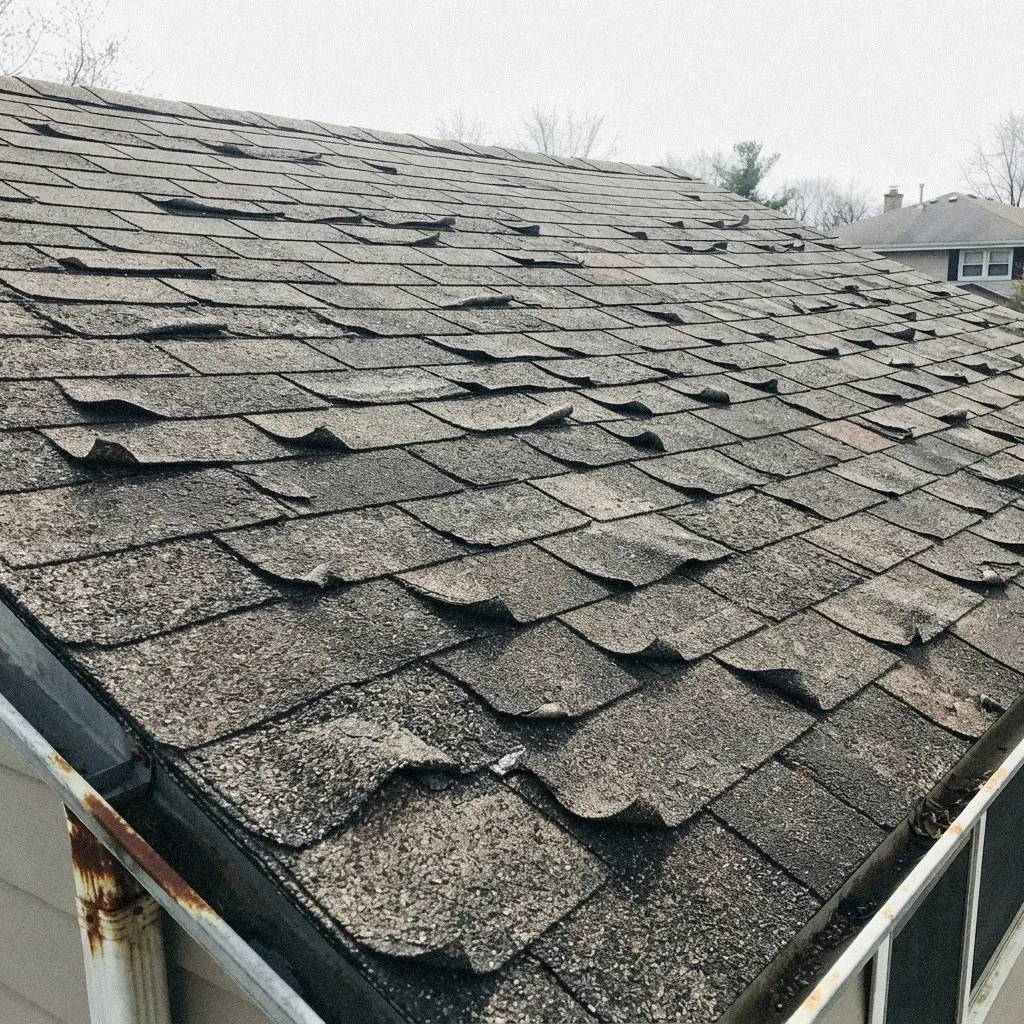
Three different words describe three stages of the same failure, and telling them apart is how you place a roof on the timeline. Cupping is the tab edges lifting into a shallow dish shape, the earliest of the three, driven by the mat drying out unevenly under Jacksonville sun. Clawing is the opposite curl, the middle of the tab rising while the edges stay put, which usually means moisture is being taken up and released from underneath. Curling is either one gone far enough that the tab no longer touches the course below it, and that is the point wind can get a grip.
Cracking and splitting show up later and mean the asphalt has lost nearly all its remaining flexibility. Instead of curling under thermal stress, the mat fractures outright, usually in a straight line across the tab. This tends to appear first on older sections of a roof, like an addition over a Panama Park or Durkeeville home built years after the original structure. Once cracking spreads across multiple courses, water finds a path through even without a storm to drive it.
| Age Bracket | Shingle Behavior | Root Cause |
|---|---|---|
| Years 1 to 5 | Corners lift slightly, rest of tab flat | Sealant strip still settling into full bond |
| Years 6 to 12 | Edges roll down, granules wash toward gutters | Repeated summer heat softening the fiberglass mat |
| Years 13 to 20 | Whole tab twists in more than one direction | Mat has dried out after years of UV load |
| Years 20 and beyond | Small domes form, then split when stepped on | Moisture or gas pocket trapped beneath the surface |
| Any age, after a strong storm | Sharp cracks run across brittle tab material | Wind uplift or debris impact during a thunderstorm |
What A Worn-Out Roof Looks Like Up Close
No shingle, three-tab or architectural, outlasts a bad install. In Jacksonville that means the right nailing height, enough fasteners per shingle, and courses run straight on a Northside or Westside roof deck that hasn't warped. Nails driven at an angle or too high miss the strip underneath and back out over time as the deck expands and contracts, a nail pop that breaks the seal long before the shingle's rated life runs out.
Ventilation and drainage shape aging as much as the shingle brand does. An attic that can't vent heat over a Riverside or Arlington bungalow pushes temperatures up under the deck, which speeds blistering and shortens the sealant strip's bond. Poor drainage toward a clogged valley or a low spot near Pottsburg Creek keeps water sitting against granules longer than it should, wearing the surface down years ahead of the shingle's expected schedule.
The Point A Shingle Roof Stops Doing Its Job
There's rarely one clear moment marking a roof's end. It's a buildup of smaller signs across a full year of Jacksonville weather. Granules keep collecting in the gutters after storms instead of tapering off. Tabs stop lying flat and stay curled or clawed even on cool mornings. Cracking spreads past isolated spots into full courses. Bald patches where the asphalt shows through get larger each hurricane season instead of staying put, and any one of these alone might not mean much, but together they add up.
The practical test is simpler than any of the signs. A roof is finished when patching it stops being worth the money, and that point arrives when the shingles around a repair are too brittle to lift without breaking. A roofer trying to slide a new tab into an old field on a twenty-two-year-old Jacksonville roof ends up cracking three shingles to replace one. Once that is happening, every repair is buying weeks, and the money is better spent on the reroof that is coming anyway before the next hurricane season.
Quick Signs Your Shingles Are Wearing Out
- Wind uplift resistance depends on nailing pattern as much as shingle grade, and a poor pattern shortens rated life on any roof.
- UV exposure, not cold, is Jacksonville's dominant aging force, breaking down the asphalt mat year over year under steady sun.
- Granule loss right after installation is normal factory shedding. Loss in bare patches after a decade signals real mat exposure.
- Cupping and clawing are stages of the same curling process, with clawing marking a further, more advanced twist of the tab.
- Nail pops usually come from deck movement or thermal cycling, not bad fasteners, and they open a small path for water.
- A roof nearing end of service life often leaks first at valleys and flashing before the open field starts failing outright.
Frequently Asked Questions
How long do asphalt shingles last in Jacksonville?
Twelve to twenty years is the honest range for most of the city, against a rated life of twenty-five to thirty on the bag. The gap comes from three things this climate has plenty of: heat that softens the asphalt daily, wetting and drying cycles through the summer storm season, and attics that were never vented properly. A well-vented roof on a shaded lot can beat that range. A poorly vented roof on a west-facing slope in Southside will not reach it.
Does Jacksonville's climate age shingles faster?
Not from cold. Jacksonville shingles age mainly from constant UV exposure and the thermal cycling of hot afternoons followed by sudden thunderstorm cooling, plus wind-driven rain working at valleys and flashing during hurricane season along the St. Johns River corridor.
Why are my shingle tabs curling upward already?
Does granule loss mean my roof is done?
Not by itself. Early granule loss after a reroof permit is normal shedding. Loss appearing as bare patches years later, alongside curling tabs or cracking near valleys, points toward a roof genuinely nearing end of service life.
Can poor attic ventilation shorten shingle life here?
Yes. Poor soffit or ridge ventilation traps heat and humidity against the underside of the deck, which speeds blistering and clawing from within. Older homes in Springfield or Avondale with undersized vents often show this first.
Curious Where Your Roof Sits On This Timeline?
Send the roof's age and what you are seeing, and the licensed pros we connect you with will place it on the timeline.
Call (904) 675-6349