What Keeps a Jacksonville Roof Attached in High Wind
How a Jacksonville roof is built, fastened, and vented to hold together against high wind.
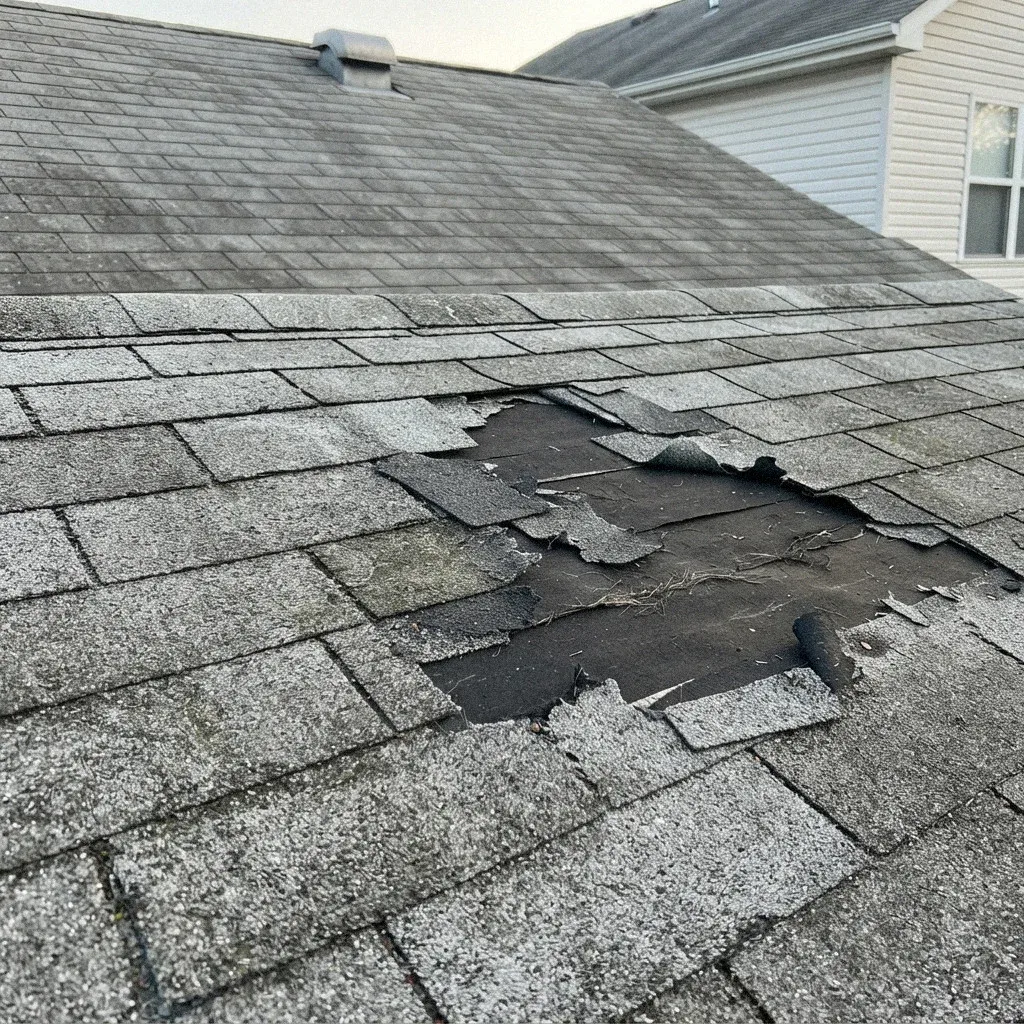
Wind uplift starts at the roof edges and corners, not the field of the roof. A wind-rated shingle only means the covering resists uplift — the deck attachment, fastening schedule, and soffit venting underneath it decide whether the whole roof survives a Jacksonville storm.
The Load Path From Shingle to Slab
A roof survives wind because of a load path, not because of any single strong part. Wind uplift pulls at the covering, the covering is fastened to the deck, and the deck is fastened to the framing below it. If any one link in that chain is weak, the strongest link above it does not matter. In Jacksonville, older Northside and Westside homes often have the covering upgraded over the decades while the deck attachment underneath was never touched.
Uplift concentrates at the perimeter and corners of a roof, not the middle. Wind rolling over a ridge or across an eave creates suction there far stronger than anywhere else on the plane, so a Jacksonville roof loses shingles at the rake and eave lines first, long before the interior ever shows a problem. That is why fastening schedules tighten at those zones instead of staying uniform across the whole deck.
Jacksonville is not in Florida's High-Velocity Hurricane Zone; that designation belongs to Miami-Dade and Broward, with far higher wind design standards than this market uses. The statewide Wind-Borne Debris Region reaches the barrier-island beach towns like Jacksonville Beach and Atlantic Beach and a narrow coastal fringe, but most of the city, including Arlington, Mandarin, and the Westside, sits outside that mandatory impact zone.
Why Edges and Corners Fail First
Ring-shank nails hold decking to framing better than smooth-shank nails because the ridged shank resists being pulled back out once it is driven. That resistance matters most where uplift concentrates, which is why fastening schedules specify tighter spacing at edges and corners and looser spacing in the field. The nail type and the spacing pattern work together; a ring-shank nail placed too far from its neighbors still leaves gaps in the load path that wind will find.
Roof deck attachment and the secondary water barrier solve two different problems, even though both sit under the shingles. Deck attachment is about keeping the plywood or OSB physically fastened to the rafters under uplift. The secondary water barrier, typically a self-adhering membrane or taped seams, is about keeping water out if the primary covering is torn away. A roof can have strong deck attachment and no secondary barrier, or the reverse; a homeowner should know which one their roof has.
- Wind lifts a Jacksonville roof at its edges and corners first, where uplift forces run highest across the covering and deck below.
- Ring-shank nails driven through shingles into solid decking hold far better under uplift than smooth-shank nails or staples ever will.
- The fastening schedule sets nail count and spacing per shingle, and it tightens at edge and corner zones compared to the open field.
- Roof deck attachment is a separate question from the covering above it — decking fastened weakly to rafters can fail even under a rated shingle.
- A secondary water barrier under the decking keeps a home dry even if wind-driven rain works past lifted or missing shingles above it.
- Gable end bracing keeps the triangular wall section at a roofline's end from racking or collapsing under sideways wind pressure.
Fastening the Deck, Not Just the Shingle
Soffit and vent openings matter more here than most Jacksonville homeowners expect, because they are how wind gets inside a roof rather than just across it. Once wind-driven rain or pressure forces its way through a soffit vent, the attic pressurizes from underneath, pushing up on the roof deck from the inside at the same time uplift pulls from outside. Homes in older sections of Riverside, Springfield, and Avondale often have original soffit vents that were never checked against current wind exposure.
Gable end bracing addresses a related but separate failure. A gable end wall, especially on older homes without continuous bracing back to the roof framing, can rack and pull away from the roof structure under sustained lateral wind. Once a gable end shifts, it can open a gap at the ridge or rake that lets wind and rain into the attic from the side rather than through the roof surface itself, which is a different entry point than soffit failure.
- Soffit vents along Arlington and Mandarin homes let wind pressurize the attic once a gap opens, pushing up on the roof deck from inside.
- Before a named storm, check that soffit panels are secure, since a blown-in soffit gives wind a straight path under the roof deck.
- Ridge vent and off-ridge vents are openings too, so their closures and fastening matter as much as the soffit end of the path.
- Debris impact from tree limbs near St. Nicholas or San Marco's older tree canopy can puncture a deck even where fastening held perfectly.
Where Wind Gets In and What It Damages
A wind rating printed on a shingle wrapper describes how that shingle performed in a specific test, using specific fasteners, on a specific deck. It does not describe the roof it ends up installed on. If the actual fastening schedule, deck attachment, or underlayment differs from what the test used, the installed roof may not perform to that rating at all. The rating is a claim about the product, not a guarantee about the finished roof over a home in Mandarin or San Marco.
Debris impact resistance is a separate question from wind rating entirely. A shingle can carry a strong wind rating and still have no rated resistance to flying debris, because those are different tests measuring different things. For most of Jacksonville, outside the coastal Wind-Borne Debris Region, debris impact standards are not mandatory, so a homeowner comparing products should ask which test a given rating actually reflects before assuming it covers both.
| Component | Wind Load | Weak Point |
|---|---|---|
| Roof covering (shingles or tiles) | First surface hit by uplift and debris | Fails fast at unsealed edges and corners |
| Roof deck (sheathing) | Loses its grip if fasteners are thin or sparse | Whole panels can lift once nails pull free |
| Secondary water barrier | Only line of defense once covering is gone | Keeps rain out of the attic during the storm itself |
| Soffit and vent openings | Let wind pressurize the attic from underneath | Push the roof deck up from the inside out |
| Soffit vents and openings | Racks and leans without cross-bracing to the frame | Can pull siding and roofline apart at the peak |
Gable Ends and the Overlooked Frame
Before a named storm reaches the Jacksonville area, the practical checks are about what wind can grab, not about the roof surface itself. Loose gutters, lifted ridge caps, and anything overhanging the roof from nearby trees near the St. Johns River or Pottsburg Creek give wind a first foothold. A roof that is otherwise sound can still lose material if a weak edge detail or an overhanging limb gives wind something to catch first.
After a named storm passes, the check is from the ground first: look for missing or lifted shingles, displaced ridge caps, and gutters pulled loose, especially at corners and rake edges where uplift concentrates. Soffit panels that look pushed in or missing are a sign wind got underneath the roof rather than just across it. None of this replaces a closer inspection, but it tells a homeowner in Arlington or the Southside whether one is needed soon.
What a Wind Rating Really Promises
Not every Jacksonville roof carries the same wind risk, and the pattern tracks exposure and construction era more than any single neighborhood name. A ranch-style roof with long, unbraced gable ends behaves differently under wind than a hip roof, which has no gable ends to brace at all and generally handles uplift more evenly across its slopes. Homes built before current fastening schedules were standard often carry more risk from deck attachment than from the shingle itself.
Homes closer to open water, along the Intracoastal Waterway or near the mouth of the St. Johns River, see more sustained wind exposure during a storm than homes further inland in Baymeadows or Mandarin, even though both sit outside the Wind-Borne Debris Region. Exposure changes how hard and how steadily wind loads a roof, not whether the building code treats the home differently, since that boundary is drawn at the coast, not by distance alone.
Before and After a Named Storm
- Jacksonville sits outside Florida's High-Velocity Hurricane Zone, which applies only to Miami-Dade and Broward, not Duval County.
- Jacksonville sits outside Florida's High-Velocity Hurricane Zone, with a wind design speed in the 120 to 130 mph range.
- Downtown Jacksonville, Riverside, and the Westside sit outside the mandatory impact-glass and shutter zone that applies along the coast.
- A wind rating stamped on a shingle wrapper describes the covering's own uplift resistance, not the deck attachment or fastening schedule beneath it.
- Load path is the chain from covering to deck to rafters to walls — the whole roof is only as strong as its weakest link.
- Salt air corrosion on fasteners concentrates near the actual coastline, not across inland Jacksonville neighborhoods like Mandarin or Arlington.
Frequently Asked Questions
Is Jacksonville in the hurricane wind-borne debris zone?
No. High-Velocity Hurricane Zone rules apply only to Miami-Dade and Broward, where design wind speeds run well above what Duval County requires. Jacksonville's building code sits in a lower wind-speed range, and even the mandatory wind-borne debris protections only reach the barrier-island towns like Jacksonville Beach and Atlantic Beach. A Northside or Westside roof is built to a different, less severe standard entirely.
Does a high wind rating mean my whole roof is safe?
No. A wind rating tested on a shingle wrapper covers only how that covering resists uplift in a lab setting. It says nothing about how the deck is attached beneath it, whether the fastening schedule was followed at edge and corner zones, or whether soffit vents were sealed. Those decide the outcome as much as the shingle does.
Why do soffit vents matter in a hurricane?
Because they are the way wind gets inside the roof instead of just over it. A soffit panel that blows loose gives wind a straight path into the attic, and once the attic pressurizes, air pushes up on the underside of the deck at the same moment uplift is pulling from outside. That doubled load is how roofs come off in one piece rather than shingle by shingle. Making sure the soffit panels are secure is one of the cheapest things a Jacksonville homeowner can do before a storm.
What should I check on my roof before a named storm?
Walk the exterior and look at soffit panels, gable end bracing, and anything loose nearby that wind could turn into debris impact, like patio furniture or tree limbs. There is no code inspection to schedule on short notice, so this is a visual check a homeowner in Arlington or Mandarin can do in twenty minutes.
What should I check on my roof after a named storm passes?
Look up from the ground for lifted or missing shingle tabs, exposed nail heads, displaced ridge caps, and any daylight visible at the roofline. Check soffits for gaps or panels blown loose. Inside, check ceilings for new stains. None of these confirm deck-level damage, which often needs a closer inspection.
Want a load-path check before hurricane season?
The licensed pros we connect you with can check deck attachment, edge fastening and soffit openings on a Jacksonville roof, not just the shingles on top.
Call (904) 675-6349