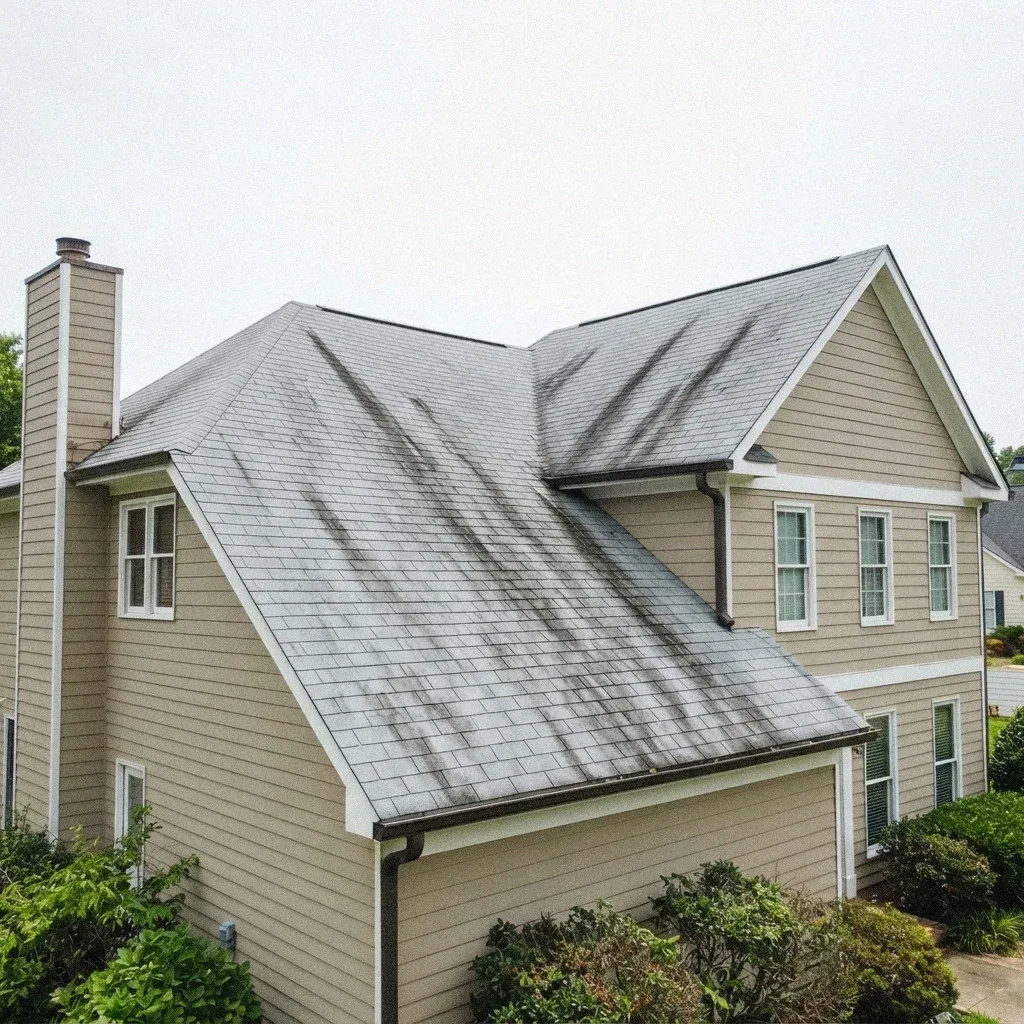
Algae Streaking and Moss on Jacksonville Roofs
Why dark streaks spread on Jacksonville roofs, what moss does differently, and which cleaning methods protect shingles.
Dark streaking on Jacksonville roofs is gloeocapsa magma, an algae that feeds on limestone in shingle granules and spreads fastest on shaded, north-facing slopes. Thick moss shows up mainly under heavy tree canopy in neighborhoods like Ortega Forest.
What Gloeocapsa Magma Actually Does
Dark streaks running down a Jacksonville roof are almost always Gloeocapsa magma, an airborne algae that lands on shingles and feeds on the limestone filler in the granules. It shows up first on north-facing slopes and shaded valleys where a roof plane stays damp longest after an afternoon thunderstorm. The streaking is cosmetic at first, but a roof left untreated for several seasons in Springfield or Riverside often develops a rougher, darker texture that signals the colony has thickened well past a surface stain.
Shade is the biggest factor in where that growth spreads across a Jacksonville home. A roof plane shadowed most of the day by live oaks common in Avondale or San Marco holds moisture long after a sunnier plane in Mandarin or Baymeadows has dried. That shade load, paired with the humidity Duval County carries through most of the year, gives algae spores a steady foothold. Homes near St. Nicholas or Ortega Forest with dense canopy overhead tend to show streaking years before an open lot in San Jose does.
Moisture retention matters more than color here. Gloeocapsa magma spreads across shaded roof planes in Jacksonville because afternoon thunderstorms keep granules damp through much of the summer, and shingles under a heavy tree canopy in Avondale or Ortega Forest rarely get a full dry-out between rounds of rain. That sustained dampness is what feeds the colony, not the streaking itself. Homeowners often treat the dark stripe as the problem, when it's really the visible sign of a roof plane that stays wet longer than its neighbors.
Shaded Slopes and Why Streaks Spread
Granule adhesion is the real cost of letting algae streaking run for years on a Jacksonville roof. Granules are pressed into the asphalt layer to block ultraviolet light, and a colony sitting on top of them traps moisture that slowly breaks that bond. Once granules start washing into the gutter after a heavy rain, the exposed asphalt underneath ages faster in Northeast Florida's sun. That loss is gradual and easy to miss from the ground, which is why a roof can look only lightly stained while shedding granules underneath.
Shingle edge lifting shows up after moisture has been sitting under a tab or along a ridge cap for a season or longer, usually where moss rather than algae has taken hold. The trapped water swells the mat and works the shingle loose at its seal line, which leaves a gap wind can catch during a summer squall. A homeowner in Arlington or Cedar Hills who notices a tab standing slightly off the surface should treat it as a sign the growth has been established a while, not a fresh problem.
- Gloeocapsa magma is the algae responsible for dark streaking, feeding on limestone filler in shingle granules across the Southeast.
- Dark streaking spreads fastest on north- and shade-facing slopes across Jacksonville, where afternoon thunderstorm runoff keeps granules damp for hours after rain stops.
- Moss builds a raised mat that traps water against the shingle, while algae stains only the surface layer without lifting or thickening it.
- Shade load is how many hours a roof section sits under tree cover, and it decides how fast algae streaking spreads.
- Moisture retention describes how long a shingle stays wet after rain, the main factor spore needs before growth starts.
- North-facing slopes and sections shaded by oak or pine hold moisture longest after Jacksonville's afternoon thunderstorms pass through.
When Moss Becomes the Bigger Problem
Pressure washing a Jacksonville roof to strip off algae or moss does more harm than the growth itself. A high-pressure stream forces water up under the shingle laps and drives granules loose on contact, which is the opposite of what a homeowner wants on a roof that already has to shed heavy summer rain toward the gutters. It can also push water past the underlayment at valleys and penetrations, the same spots already under stress during a hurricane-season downpour. The clean look it leaves behind hides damage that shows up as a leak months later.
The chemical does its work over minutes, not seconds, which is why a rushed pass leaves patches of algae still clinging near ridge lines and valleys. A sodium hypochlorite solution needs contact time to break down the organism's cell structure before any rinsing starts. Rinsing too early just wets the surface without finishing the kill, and the streaking returns within a season. Applied correctly, the same section of roof shouldn't need retreatment again for a couple of years.
- Algae streaking alone rarely lifts shingles, but it does erode granule surface, exposing the asphalt layer beneath to sun.
- Moss growing under a tab lifts the shingle edge as it thickens, breaking the seal against wind-driven rain.
- Around plumbing stacks and chimney flashing, trapped moss holds runoff longest, so granule loss and softened mat often start there first.
- Shingle edge lifting from moss shows up most at slope bottoms and ridge lines, where water sits longest after storms.
Algae, Moss, and Lichen Side by Side
Homeowners who want to slow regrowth after a soft wash sometimes look at zinc or copper strips fastened along a ridge. Rain washing over the metal carries a trace amount downslope, which discourages new spore growth on that plane going forward, though it does nothing for growth that has already taken hold lower on the roof. It's a preventive add-on, not a substitute for cleaning, and it works best on roofs with heavy tree cover, like homes tucked under oak canopy in Ortega or parts of Arlington Hills.
Algae-resistant shingles take a different approach by building copper compounds into the granules at the factory, so protection covers the whole roof plane instead of just the area below a metal strip. For a Jacksonville reroof, that's worth asking about directly, since standard shingles on a shaded lot in Panama Park or Moncrief Park can show streaking again within a couple of years. It costs more upfront than a standard shingle, but it removes the need to think about strips or repeat cleanings as often.
| Growth | Look | Roof Risk |
|---|---|---|
| Gloeocapsa magma | Dark gray-black streaks, worst on shaded slopes | Eats granules, dulls the shingle surface |
| Thick moss | Raised green clumps under tree canopy | Holds moisture, lifts shingle edges |
| Algae streaking | Crusty gray-white rings fused flat to the surface | Grips granules tightly, hard to remove without loss |
| Bare algae streak | Thin dark trails running down from the ridge | Cosmetic at first, spreads with each rain |
| Established moss mat | Dense pad thick enough to hide the shingle | Traps water against the deck year-round |
Soft Washing Versus Pressure Washing
Tree canopy trimming is often the more lasting fix, because it addresses why a roof stays wet instead of just what's growing on it. Thinning branches that hang directly over a roof plane in a heavily wooded yard in Ortega Forest or Girvin lets morning sun and airflow reach the shingles sooner after rain. A roof that dries within a few hours holds far less appeal for algae spores than one that stays damp under a canopy through most of a Northeast Florida afternoon.
A homeowner deciding between tree work and a cleaning schedule should think about which planes of the roof actually stay wet longest, not just how much shade the yard has overall. A single oak shading one corner near Fishweir Creek or Pottsburg Creek can be enough to keep that section damp while the rest of the roof dries fine. Trimming that one problem branch sometimes solves more than a full soft wash treatment repeated every couple of years without addressing the shade itself.
Zinc, Copper, and Trimming Back Trees
How often a Jacksonville roof needs attention for algae or moss depends more on shade than on the age of the shingles. A heavily shaded roof in San Marco or Eastside under mature tree cover may need a soft wash every couple of years, while an open roof in Baymeadows or Southside with little overhead canopy might go much longer between treatments. Roofs that catch runoff from a neighboring tree line, common near Julington Creek or McGirts Creek, tend to fall on the shorter end of that range.
Rather than working off a fixed calendar, it helps to look the roof over after the heaviest stretch of Duval County's summer rain and again once hurricane season winds down. That timing catches new streaking or a lifted tab before it sits through another wet season. A quick look from the ground after a storm rolling in off the Intracoastal Waterway or up from Jacksonville Beach is often enough to tell whether it's time to call in the licensed pros we connect you with for a closer inspection.
What Grows on a Jacksonville Roof
- Zinc strips and copper strips release trace metal that rinses down the slope with rain, slowing new algae and moss growth below.
- Pressure washing composition shingles strips granules and forces water under tabs, often causing more damage than the algae itself.
- A soft wash kills the growth at the roots without stripping granules, unlike pressure washing, which can shorten a shingle's remaining service life.
- Algae-resistant shingle includes copper granules built into the product, worth asking about when a reroof is already planned.
- Zinc or copper strips along a ridge send trace metal into runoff each time it rains, slowing regrowth on the slope below.
- A check timed to spring, before hurricane season's heaviest rain, catches algae streaking and moss before they spread further.
Frequently Asked Questions
Will pressure washing damage my shingles?
On its own, dark algae streaking is cosmetic and won't cause a leak. The concern is what it signals: granules holding moisture longer than they should, which over years can wear down that protective layer faster than sun exposure alone. If the streaking is spreading fast or you're also seeing curled edges near Springfield or San Marco's older shingle roofs, that's worth a closer look, not just a cleaning.
What causes the dark streaks on my roof?
Duval County claims usually need a licensed inspection report with dated photos showing granule loss or mat cracking traced to a named storm, not just general algae discoloration. Jacksonville adjusters typically separate storm damage from ordinary weathering, since dark streaking on its own reads as maintenance, not a covered event.
Is moss worse than algae streaking?
Algae streaking is cosmetic at first but keeps eating granule surface over years, while moss is the one that causes structural trouble. Moss holds water against the mat and grows thick enough to lift shingle tabs, mainly on roofs shaded by dense tree cover in spots like Ortega Forest or San Jose.
How often should a Jacksonville roof be cleaned?
A sunny Jacksonville roof can go three to four years between cleanings, but shaded sections under oak canopy in neighborhoods like Avondale or Murray Hill may need attention every two years. Afternoon thunderstorms through the summer keep those slopes wet longer, which speeds both algae streaking and moss growth.
Do copper strips stop algae from coming back?
Zinc and copper strips near the ridge release metal ions that wash down with rain and slow regrowth of algae and moss on the slope below. They do not remove existing streaking, and results vary with how much rain a Jacksonville roof gets between hurricane season storms.
Ready to have algae or moss checked?
Have the licensed pros we connect you with check algae streaking or moss on your Jacksonville roof before granule loss sets in.
Call (904) 675-6349