The Four Roof Inspections Jacksonville Homes Need
Maintenance, pre-purchase, post-storm and warranty checks, and what each one is actually looking for.
A Jacksonville roof inspection is a visual and instrument-assisted check of shingles, flashing, the attic, and gutters to catch leaks, worn spots, and storm damage before the next round of afternoon thunderstorms or a tropical system finds them first.
Maintenance, Sale, Storm, or Warranty
Different reasons bring an inspector to a Jacksonville roof, and they are not the same visit. A maintenance check is the yearly look you book yourself. A pre-purchase check is timed to a closing and written for a buyer. A post-storm check is narrow and event-driven, aimed at what a named storm did last week. A warranty check exists to prove the terms of a manufacturer's coverage are still being met. Knowing which one you are asking for changes what the inspector prioritizes and what the report ends up saying.
All four begin with the same walk-around, though the order can shift depending on what prompted the visit. On a maintenance or warranty call, the inspector usually starts on the roof surface itself, since nothing has forced attention elsewhere yet. On a post-storm call, the attic often comes first, because a punch-through or lifted flashing shows itself as light or moisture inside long before it shows on the shingles. Either way, the same ground gets covered before the visit ends.
What changes between them is the write-up, not the roof. A post-storm report needs dated photographs tied to a specific event, because that is what a Duval County adjuster will read. A pre-purchase report needs a condition rating and a rough cost of what comes next, because that is what gets negotiated. A warranty report needs to answer the manufacturer's own questions in the manufacturer's own terms. Booking the wrong one usually still gets the roof looked at properly; it just leaves you holding a document the person who asked for it will not accept.
What the Pros Actually Check
Exterior scope covers the roof surface in Jacksonville homes from Arlington to Mandarin: lifted or missing shingles, granule loss, blistering from sun exposure, and any patch job left by a prior repair. A penetration survey checks every pipe boot, vent stack, and skylight curb, since these small fittings fail long before the surrounding field does. On tile or metal roofs common around Ortega Forest and San Jose, the inspector also looks for cracked tiles, popped fasteners, and panel seams that have started to separate.
A flashing check follows, since Jacksonville's mix of older bungalows in Avondale and newer construction near Southside means chimney, wall, and dormer details vary widely from house to house. Loose or rusted flashing at these transitions is where wind-driven rain from a tropical system usually gets in first. Valleys get looked at for granule buildup and any sign that water has been sitting rather than draining, which matters more here given how heavy Jacksonville's summer rain totals run between June and September.
- Each roof slope gets walked or viewed for lifted shingles, granule loss, and any soft spot that gives underfoot, a sign decking underneath may be failing.
- Flashing at chimneys, valleys, skylights, and wall junctions gets checked separately, since these transitions cause more leaks than the open shingle field ever does.
- Gutters and downspouts get looked at as part of the roof, since a run holding water rots the fascia the roof edge sits on.
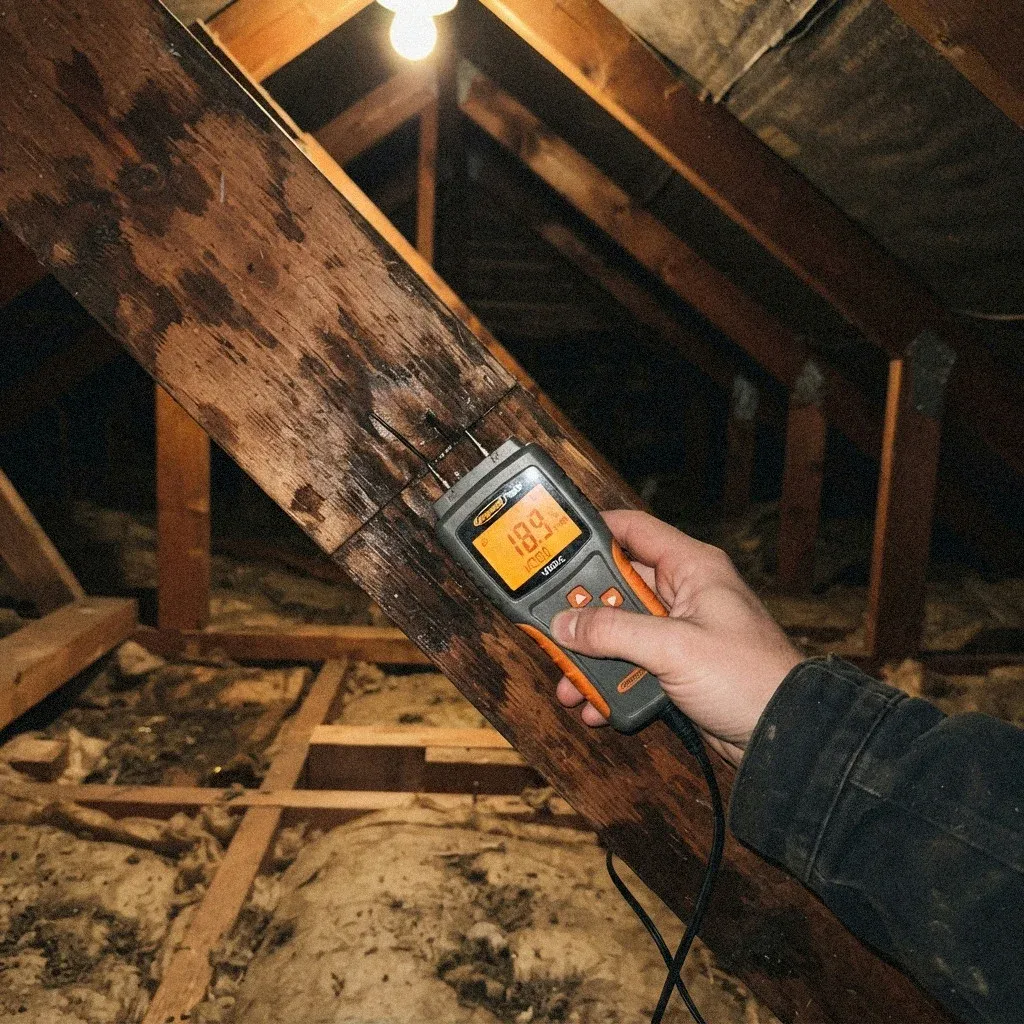
- The attic gets viewed from underneath for staining, wet insulation, and daylight coming through a gap, plus a check that ridge and soffit vents sit clear.
- Every plumbing stack, vent, and skylight curb gets counted and looked at up close, since a cracked pipe boot lets water in season after season.
- A dated photo gets tied to each finding and its location on the roof, so a homeowner in San Marco or Murray Hill can match report to roof.
Turning a Roof Walk Into a Record
An inspection that lives only in the inspector's head is worth very little a month later. The record is the product, and it should be built while the inspector is still on the roof rather than written from memory in the truck afterward. That means a photograph taken at each finding, a note of where on the roof it sits, and a rating of how urgent it is, all captured in order as the slopes get covered.
Location is the part most reports get wrong. A photograph of a cracked pipe boot means nothing in two years if nobody wrote down which slope it was on. A useful report ties each finding to something you can find again from the ground: the slope facing the street, the valley above the garage, the third stack from the west end. That is what lets a homeowner in San Marco hand the report to a different roofer later and have them go straight to the spot.
- A maintenance inspection is a routine yearly check meant to catch a lifted shingle or clogged gutter before the next hurricane season arrives.
- A pre-purchase inspection is scheduled around closing on a home, giving a buyer a condition rating to negotiate price or plan a near-term reroof.
- A post-storm inspection follows wind or a fallen limb, narrowly focused on impact marks, lifted flashing, and openings, not a full top-to-bottom review.
- A warranty inspection is booked on the manufacturer's schedule and exists to document that the coverage terms are still being met.
A Report Is Not a Repair Quote
An inspection tells you what condition the roof is in. A quote tells you what one company will charge to change that condition. They are different documents with different jobs, and a report that arrives with a price on the bottom of it is really a sales proposal wearing an inspection's clothes. Ask up front whether the inspection is being done independently or as the front end of a bid, because the answer changes how much weight the findings deserve.
What collects in a Jacksonville gutter depends on what's growing nearby. Homes along tree-lined streets in Avondale or Riverside collect leaf litter and seed pods that build up fast between cleanings. Properties closer to Big Talbot Island or Little Talbot Island pick up more sand and salt residue in the mix. Either way, a gutter packed tight enough to overflow at the fascia board turns a working roof into a source of water damage at the eaves.
| Type | When You'd Use It | Report Outcome |
|---|---|---|
| Maintenance inspection | Checks general upkeep, no known problem | Set on a regular interval, owner's choice |
| Pre-purchase inspection | Confirms condition before closing on a home | Scheduled during the sale's inspection period |
| Post-storm inspection | Checks for wind or hail damage after a specific event | Booked right after a Duval County storm passes |
| Warranty inspection | Confirms terms are being met for coverage | Tied to manufacturer or workmanship schedule |
| Best used for | Confirming coverage stays active | Fastener corrosion, expired underlayment, denied claims |
What the Condition Rating Means
Most reports grade each finding on a short scale, something like good, fair, poor, or a number band standing in for the same idea. The words matter less than what sits behind them. A rating should answer one question: roughly how long can this be left alone. Good means leave it and look again next year. Fair means plan for it. Poor means it is already letting water in or will before the next hurricane season ends.
The condition rating attached to each finding is what turns a page of photos into something usable. It's a judgment call about how much service life is left in that specific area, not a verdict on the whole roof. A field with a fair rating and a valley with a poor rating are two different problems needing two different timelines, and lumping them together into one overall grade for a Jacksonville home hides exactly the detail a homeowner needs to act on.
Turning Findings Into a Plan
A report with a long list of findings on it is not a to-do list in the order it was written. Sort it by consequence. Anything letting water into the house goes first, whatever it costs. Anything that will let water in during the next few months of summer storms goes second: an open flashing joint, a split pipe collar, a lifted section of ridge cap. Cosmetic items and general wear go last, or into the reroof budget rather than a repair visit. Working the list that way usually costs less over three years than working it top to bottom.
This separation matters most when more than one contractor gets involved, which happens often after a storm moves through Jacksonville and multiple estimates come in. An inspection report done independent of any bid gives a homeowner something neutral to measure those estimates against — did this bid address the flashing check findings, or only the obvious shingle damage? Skipping straight to a bid without a report means trusting one party's read on both what's wrong and what it costs to fix.
Roof Inspections, The Short Version
- An inspection is only as good as the record it leaves behind, so ask what the report will include before booking.
- Wind-driven rain at valleys and penetrations causes more Jacksonville leaks than open shingle wear, since summer storms push water sideways under loose edges.
- Soft decking in a Jacksonville attic usually points to trapped moisture from a flashing gap or blocked vent, not termites or rot from age alone.
- A condition rating is per finding, not per roof, so a poor valley on an otherwise fair roof is one repair rather than a reroof.
- Test squares, small marked sections of roof measured closely, help an inspector estimate remaining shingle life without checking every square foot.
- Late spring is the useful time to book one here, ahead of the June-through-September rain rather than after it has found the weak spot.
Frequently Asked Questions
What actually gets checked during a roof inspection?
Four areas, in roughly this order: the roof surface slope by slope, every transition where the roof meets something else, every pipe and vent going through it, and then the attic from underneath. Gutters and the drip edge get folded into the first pass. The attic half is the one that gets skipped most often and the one that shows a slow leak earliest, so confirm it is included before booking.
What makes a pre-purchase roof check different?
A pre-purchase inspection is timed around a real estate closing, so it produces a condition rating a buyer or lender can act on, not just a punch list. It flags whether the roof has years left, whether past repairs near valleys or penetrations were done correctly, and what a new owner should budget for soon.
Do inspectors climb up or just look from the ground?
Both. The inspector walks or views each slope by eye first, then brings in a moisture meter on sheathing that looks discolored, and sometimes an infrared scan to spot temperature differences that hint at trapped water under the covering. Tools settle what eyes alone can't confirm on a Jacksonville roof after heavy rain.
When would an inspector cut a core sample?
Rarely on a house, and almost never without asking first. A core sample means cutting a small plug through the covering and layers below to see how many there are and whether the insulation is wet. It belongs on flat and low-slope roofs, usually commercial ones, where nothing else will tell you what is under the membrane. On a Jacksonville shingle roof a moisture meter and an attic look answer the same question without making a hole that has to be patched.
Can I use the report to get repair pricing?
Not directly, and that separation is useful. The inspection report lays out condition and findings with photos; a bid then prices a defined scope of repair against those findings. Keeping them apart lets a homeowner compare multiple bids against the same set of facts instead of trusting one company's numbers alone.
Want a roof looked at the right way?
Call and say what prompted it, whether upkeep, a sale, a storm, or a warranty, and the licensed pros we connect you with will book the right visit.
Call (904) 675-6349