Dark, glossy bald spot on one shingle face
Dark, glossy patches on the shingle face, seen from the ground or a ladder, mark where the granule coating has worn through to bare asphalt. That spot ages faster than the rest of the roof from here on.
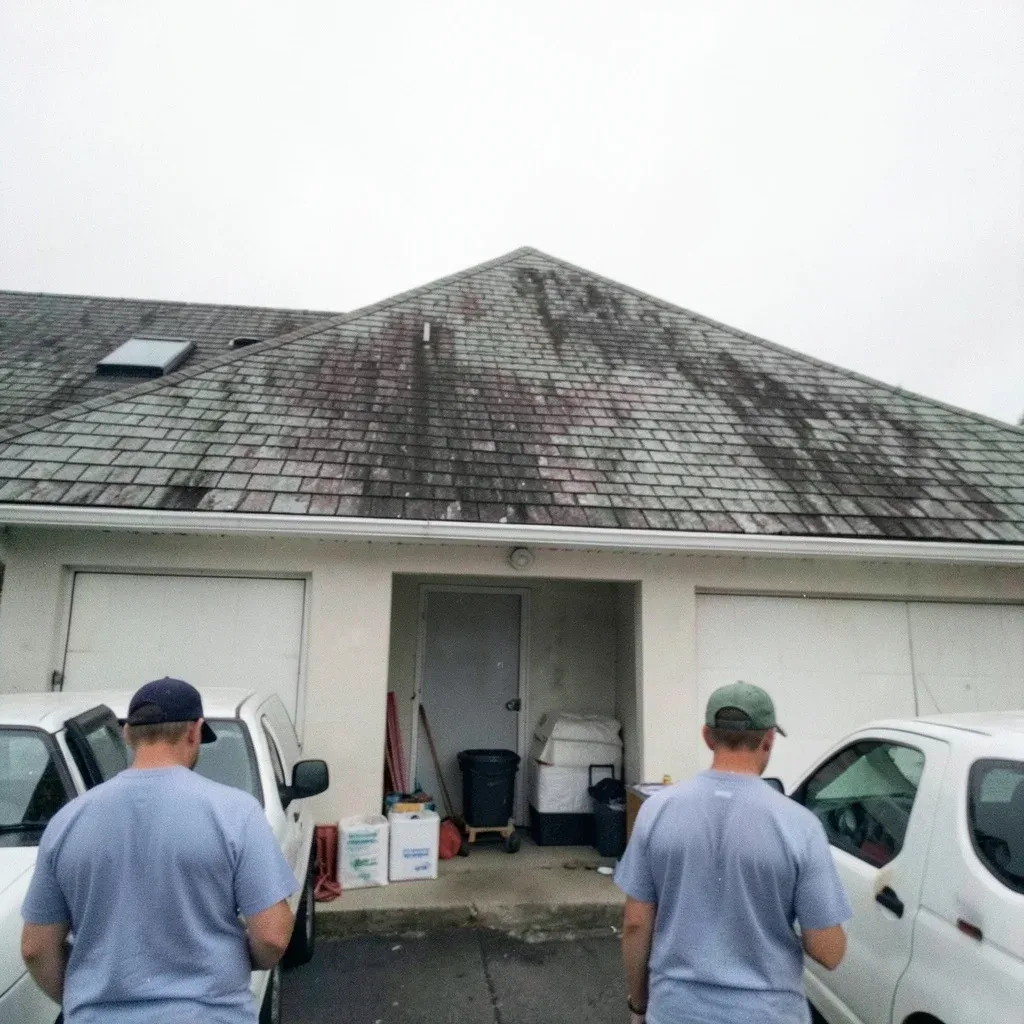
Late spring, before Jacksonville's afternoon thunderstorms roll in daily, is a good window to check for bare patches while the roof is dry and contrast between worn and intact shingle is easiest to see from the yard.
Granule loss is the sandy coating wearing off asphalt shingles, leaving dark, glossy patches. It usually starts near the ridge and rake edges in Jacksonville's sun, and it lets water reach the mat and decking underneath faster.
Wind doesn't need to peel a whole roof to cause damage. A single lifted shingle tab lets water underneath on the next storm, and that small opening does more harm over a few months than the wind gust that started it.
Dark, glossy patches on the shingle face, seen from the ground or a ladder, mark where the granule coating has worn through to bare asphalt. That spot ages faster than the rest of the roof from here on.
Sandy grit collecting in the gutters or at the downspout base after rain confirms granules are actively shedding, not just old debris. Regular grit buildup on an older roof points toward advancing wear across that slope.
Bare patches clustered along the ridge or hip lines mean the highest points of the roof are taking the most direct sun and heat, wearing faster than the shaded lower slopes near the eave.
Curling shingle edges next to bare spots mean the mat underneath is drying and stiffening, not just losing surface grit. This pairing usually means the shingle is near the end of its service life.
Fine grit or sandy residue on attic insulation below a roof penetration or soffit vent means loss has gone past cosmetic and enough is missing to let debris and heat through the substrate.
Granule loss in Jacksonville reads as a full reroof once bare patches spread across more than one slope rather than sitting near a single pipe boot or vent. Wide, scattered wear means the whole field is aging out together.
Paired with curling tabs or fastener heads working loose along the same courses, the shingle mat has lost its flexibility everywhere, not just where the sun hits hardest, and patch repairs won't hold evenly across it.
A reroof quote for a Jacksonville home should list tear-off, decking, underlayment and disposal as separate lines, not one number. Ask for the same breakdown whether the work is near the St. Johns River or further out toward Argyle Forest, so two bids can actually be compared side by side.
Granule loss gets confused with algae streaking, since both leave dark marks across a shingle roof visible from the driveway or yard. Algae grows in long streaks following water flow; granule loss sits in fixed patches that never move or wash off. Wet a hose down the streak. Algae softens and can lighten with a gentle rinse and time, since it's a living growth on the granule surface. Bare granule loss stays exactly as dark and shiny after rinsing, because there's no coating left to clean.
Where granule loss is confined to a slope or two, the treatment is replacing those sections and leaving the sound ones alone, which is why a proper look at every plane comes before any price. Where it has spread across the field, the roof is at the end of its service life and the money goes into a reroof rather than into patches that will be surrounded by bare shingle within a season.
Sealing a bare patch with roofing cement slows water reaching that one spot but does nothing for granule loss spreading elsewhere on the same slope, and it can mask sealant failure that needs a closer look.
Concrete block construction with a shingle or tile roof covers most of this area, though the exact mix depends on when a neighborhood was built. Sandy soil drains fast, which helps, but sun and humidity still wear down roofing materials year after year regardless of what sits underneath them.
| What you have | The sensible option |
|---|---|
| A single leak with a clear source | A one-off repair |
| The same leak coming back in the same place every winter | A planned re-roof |
| Anything where the sheathing is soft underfoot | Full tear-off and replacement |
From the ground or driveway, a homeowner can scan the roof with binoculars for dark, glossy patches and check gutters after rain for gritty buildup. Confirming how far the wear reaches into the field belongs on a ladder or the roof itself, best left to the licensed pros we connect you with.
Granule loss on its own isn't a health hazard. The risk is what bare asphalt lets in: water reaching the decking through a weak spot near a valley or penetration can soften the substrate and, with poor attic airflow, invite mold growth over time.
Putting right granule loss from uv and heat usually runs an estimated $400 to $2200. That is a budgeting figure, not a price. Termites, not roof-borrowing rot alone, drive real cost swings around Jacksonville, since Duval County's sandy soil and humidity keep subterranean colonies active most of the year. A licensed inspector checking a roof near Springfield or Arlington will flag any decking softness, but termite treatment itself is a separate call, priced and scheduled apart from reroofing work. pricing guide.
Flashing Failure. Failed step flashing is the metal woven up a wall behind the siding, letting water in where a roof slope meets that wall.
Drainage. Gutter overflow in heavy rain is water sheeting over the front edge of a blocked, misaligned, or sagging gutter instead of draining through the downspout, most visible along the eave during a downpour.
Storm Damage. Wind-lifted and missing shingles appear as raised tabs, bare gray patches, or torn-off pieces after Jacksonville thunderstorms or hurricane-season gusts.
No. Granule loss on one slope of a Jacksonville roof doesn't mean the whole roof needs replacing, but it does mean that slope's shingles are aging faster than the rest and should be checked before hurricane season arrives.
A little grit in the gutter after a hard summer rain is normal on a newer roof settling in. The concern is dark, glossy bare patches spreading across the shingle face, especially near the ridge or hip lines.
Rarely, once loss has spread past a small cluster near one penetration. A licensed roofer can sometimes patch an isolated section, but shingles worn wide across the field are past matching and usually call for a full reroof.
Direct sun and attic heat are the main drivers here, and Jacksonville's long, hot stretch from late spring through summer keeps shingle surfaces hot for months, which wears the granule coating faster than shade or cooler climates would.
A roof holds up fine against one hard afternoon storm. It's the repeat pressure that wears it down: sun baking the same shingles for years, wind lifting an edge a little further each season, water sitting in a low spot after every downpour until the layer underneath finally gives out.
Call (904) 675-6349