Apartments & Multifamily
Multifamily Roofing
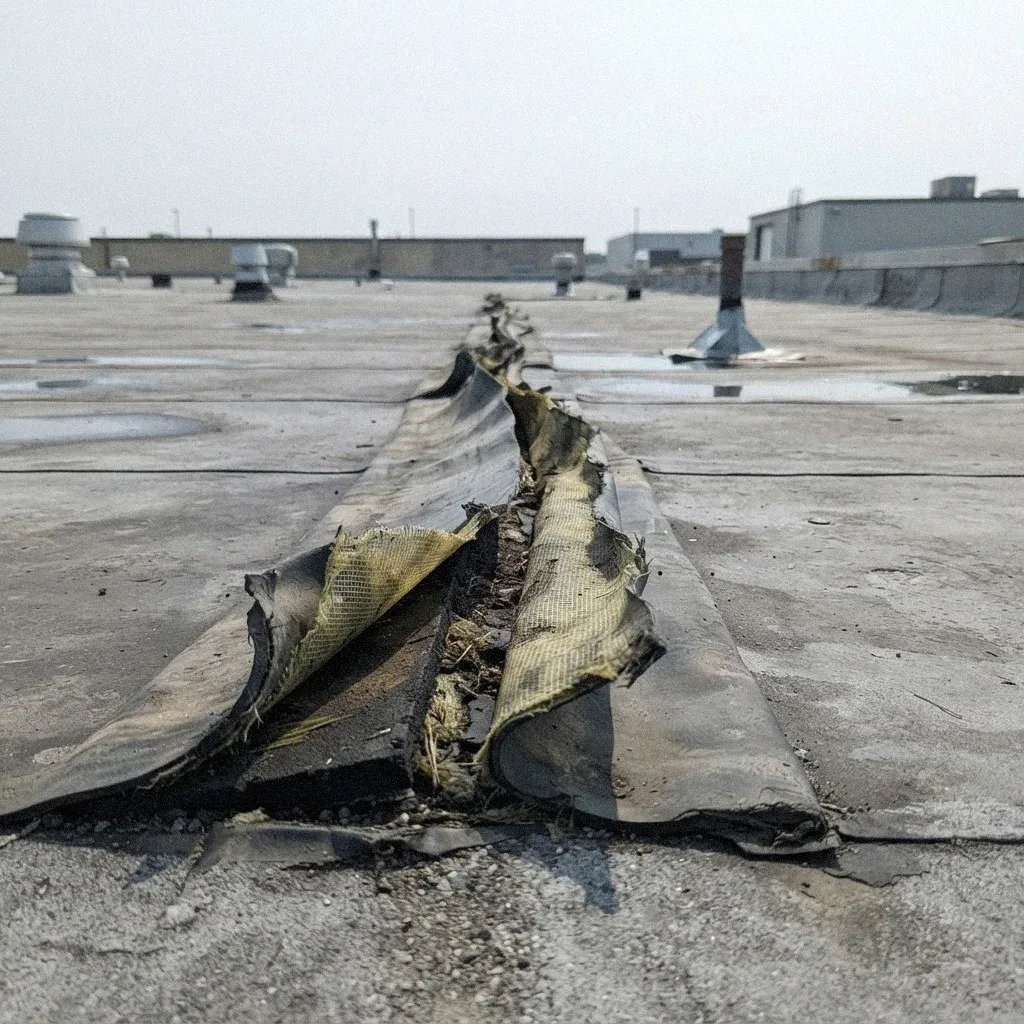
Section-by-section work across a large single-ply roof, without stopping dock operations.
Warehouse and light industrial roofs in Jacksonville are single-ply membrane, replaced or repaired bay by bay so racking, product, and dock traffic keep moving. Work centers on field seams, internal drains, overflow scuppers, and aging skylight panels across the open interior.
A warehouse or light industrial building along the Southside Boulevard and Butler Boulevard corridor near Baymeadows is one open interior under acres of single-ply, and that scale changes the math on a Jacksonville reroof. There is no wall breaking the field into manageable pieces, no separate small roofs to sequence around each other. It is one deck, one membrane run, one weather window, and every decision about phasing has to account for the whole span at once.
Because the field is continuous, the licensed pros we connect you with plan a Jacksonville reroof by dividing it into bays and moving through them in order, closing each one out before opening the next. That keeps the building watertight overnight even mid-project, which matters given how fast Duval County afternoon thunderstorms can build in summer. A roof left half-open between visits is a bad bet against that kind of weather.
A single-ply roof this size in Jacksonville rarely fails in one dramatic spot. It ages across the whole field at once, and trouble tends to surface in several bays the same season as fasteners back out, seams lose adhesion, and flashing at penetrations dries out. That pattern is why an inspection of a warehouse this size usually turns up a list, not a single repair, once someone actually walks all of it.
On a mechanically fastened system, rows of fasteners run through insulation board into the metal deck or purlin below, holding the membrane down against Jacksonville's wind exposure through hurricane season. A fully adhered system skips the exposed fastener rows in favor of bonding the sheet directly to the board, trading a different failure mode for the wind-uplift risk the fastening pattern is built to resist. Either way, the field seams between rolls are where the system is tested first.
Across acres of roof, seam length runs into the thousands of linear feet, and even a low failure rate per foot adds up to a real number of weak points somewhere in the field. Heat-welded or adhesive-bonded seams that were sound when installed can open years later as the membrane shrinks and shifts with Jacksonville's heat cycles, which is why seam inspection matters more on a roof this size than any single flashing detail.
| Stage | What Gets Done | Cost of Skipping It |
|---|---|---|
| Attachment method | Mechanically fastened system | Fully adhered system |
| Field seam count | More seams, fastener rows | Fewer seams, bonded laps |
| Wind uplift resistance | Tied to fastening pattern | Tied to adhesive bond strength |
| Metal deck condition | Purlin spacing checked bay by bay | Insulation board must sit flat first |
| Bay phasing | One bay sealed before next opens | Racking below stays covered throughout |
| Skylight panel check | Aging translucent panels tested for cracking | Failed panel drops rain onto product |
| Drain and sump check | Sumps cleared, overflow scupper confirmed | Open floor space floods fast without it |
| Dock staging | Materials staged clear of dock lanes | Blocked bay stalls loading and shipping |
Drainage on a roof this size runs through internal roof drains built into the field rather than gutters along an edge, with overflow scupters as the backup if a drain line clogs or backs up. Given how much rain Duval County gets between June and September, those drains are doing real work every time a storm rolls through, not just during named hurricanes. A blocked drain on a roof this flat has nowhere convenient to send the water instead.
Each drain sits in a sump, a shallow low point in the deck built to pull water toward the opening instead of letting it spread across the field. Sumps flatten out over the years as the insulation board underneath compresses, and a flattened sump stops doing its job quietly, long before anyone notices standing water near a drain that used to clear on its own after every Jacksonville downpour.
The scale of the roof means a drainage problem rarely stays contained to one spot. If a drain near one bay is clogged or its sump has gone flat, water finds the next low point instead of leaving the roof, and that low point may sit nowhere near the original drain. Checking every drain and scupper on a roof this large, not just the ones near a known leak, is part of what a proper inspection covers.
Translucent skylight panels turn up on a lot of older warehouse roofs around Jacksonville's industrial stretches near the airport and along the Westside, letting daylight into buildings that otherwise have no windows across most of the floor. They are also usually the oldest material up there, installed with the original roof and never touched since, and fiberglass or acrylic panels that age get brittle and crack long before the surrounding membrane shows any wear.
Because each panel sits inset into the membrane rather than sitting on top of it, swapping one out means cutting into and resealing the surrounding field seam, not just unbolting a fixture. Skipping that step, or rushing it to save a bay's worth of time, is how a skylight replacement turns into a new leak six months later once the patched seam meets its first real Jacksonville thunderstorm.
On a warehouse the roof itself is rarely the expensive part of a claim. What sits underneath it is. A leak that would just stain a ceiling in a house can mean pallets of product, packaged goods, or raw material damaged by water finding its way down through racking below, and that damage adds up faster than the roof repair that caused it.
Exhaust fan curbs are a common leak point on these roofs, since each one penetrates the membrane and sits directly above whatever operation runs below, often ventilation for a loading area or a process line. Protecting what is underneath during the work is worth putting in writing before anyone starts: poly sheeting over racking and product in the bays being opened, and specifically over anything positioned below a curb or drain being serviced.
Staging a reroof around a working warehouse in Jacksonville usually comes down to loading dock access. Membrane rolls, insulation board, and fastener boxes have to get up onto the roof somehow, and if that route runs through or near an active dock, someone has to know which doors run on which schedule before a start date gets set, not after equipment shows up.
This is less about the roofing work itself and more about not shutting down a business that depends on that dock staying clear during business hours. A project planned around Jacksonville's loading schedule, and around the afternoon thunderstorms that show up reliably through the summer months, tends to move in the sequence that keeps trucks moving rather than the sequence that would be fastest on an empty building.
Loading dock traffic on a Jacksonville warehouse, whether it sits off Southside Boulevard or out near the Westside along Blanding Boulevard, doesn't stop because a reroof is underway. Materials stage clear of active dock doors, and the bay sequence typically saves the busiest dock section for last, so trucks headed toward I-295 or the Baymeadows corridor keep loading without dodging open roof sections overhead.
Afternoon thunderstorms find small gaps at flashing and seams, and water travels sideways under shingles before it ever reaches the ceiling below. By the time a homeowner spots discoloration, the leak has usually been active for weeks. Regular attic checks catch what a glance at the roofline from the yard cannot.Mandarin, Ortega and Sandalwood. Jacksonville roofs mostly wear down through small, repeated exposure rather than one dramatic event. Afternoon thunderstorms push water under lifted shingles, sealant dries out in the heat, and debris sits in valleys until it finds a seam. By the time a stain shows indoors, that path has usually been open for a while.
A written estimate should spell out what happens at penetrations, valleys, and the roof edge, not just list a shingle brand and a price. Ask what's included if decking underneath turns out to be soft, and get that answer before any work starts, not after.Every estimate near San Marco or out toward Mandarin reflects what's actually on the roof, not a flat citywide number. Steep pitches, layered shingles, or decking softened by years of afternoon thunderstorms all change the math once a licensed pro is up there measuring instead of guessing from the driveway. pricing guide, and the commercial overview covers how a scheduled program works.
Multifamily Roofing
Condo & HOA Roofs
Commercial Roofing
Yes. Warehouse and light industrial reroofs in Jacksonville typically run section-by-section across bays, so racking and product below stay covered and loading dock access stays open through most of the job. One bay closes out with sealed seams before the next opens, which is what keeps operations underneath from facing a fully exposed roof at any point.
Translucent skylight panels age faster than the membrane around them. Yellowing, hazing, or hairline cracking in the plastic shows up years before the field membrane wears, and a leak often starts at the curb where the panel meets the roof rather than in the open field itself. Flagging a cracked panel early avoids water reaching racking or product below.
There's no fixed schedule since it depends on the panel material and sun exposure, but yellowing, hazing, or surface cracking are the signs worth checking during any roof inspection. Jacksonville's sun and summer heat push plastic panels to show wear well before the surrounding single-ply membrane does, especially on an older building.
Sequencing by bay keeps a large single-ply roof weathertight through the whole job. One section closes out, seams sealed, before the crew opens the next, so the building is never sitting with its entire roof exposed to a Jacksonville afternoon thunderstorm at the same time, and dock operations below keep moving section by section.
Get a bay-by-bay sequencing plan for your Jacksonville warehouse roof from the licensed pros we connect you with.
Call (904) 675-6349