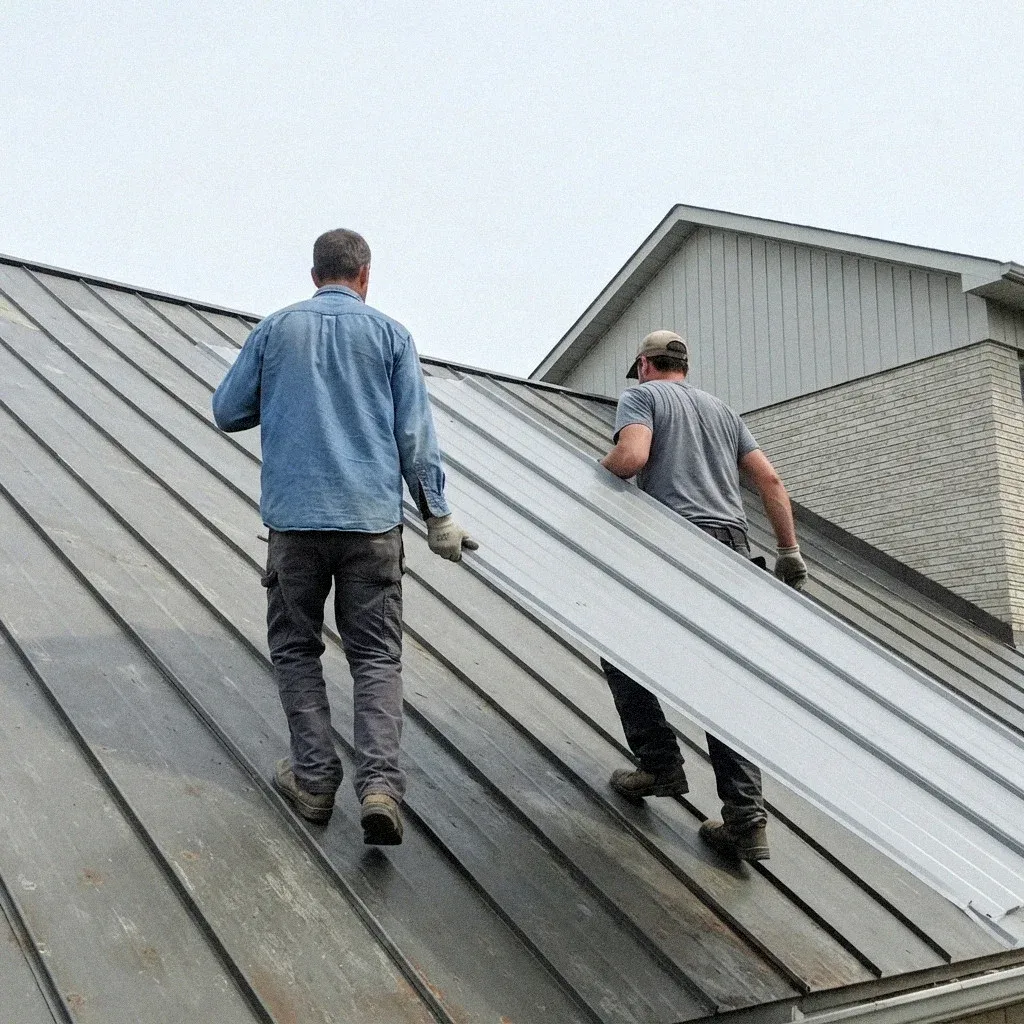
Drive through Mandarin or San Marco and you can name a metal roof's family from the driveway. Standing seam rises in narrow ribs with no screw heads showing, the panels locked together or snapped over a concealed clip so the metal can slide as it heats and cools. A corrugated or ribbed panel bolted down with neoprene washer screws stays put by force, not design, and those washers eventually give out under Jacksonville's sun. One hides its fasteners, the other wears them on the surface.
Seam Types At A Glance
Look at the seam. Standing seam ribs stand tall, usually an inch and a half to two inches, and either snap together (snap-lock seam) or get crimped shut with a mechanical seamer (mechanically seamed). No screw heads show anywhere on the field of the panel. Exposed-fastener panel has a shallower rib and a visible row of screws marching down every flat, spaced every couple of feet.
Reading The Fastener Pattern
The fastest way to tell them apart from the ground or a ladder is to look for screw heads. If you see a neat grid of fastener heads running down each panel, that's exposed-fastener metal, most often R-panel or corrugated panel. If the panel face is clean and the only visible lines are the raised ribs themselves, with no metal showing at the top of each rib, that's standing seam with a concealed clip holding it down from underneath.
What A Neoprene Washer Does
Each screw on an exposed-fastener roof carries a neoprene washer that squeezes tight when driven correctly. That washer is the entire seal at that point, and it hardens under Jacksonville's sun over the years. Standing seam skips that risk almost entirely. Its clips sit hidden beneath the seam, so the panel can slide slightly as it heats up without ever loosening a fastener or breaking a seal.
Why Concealed Clips Skip That Risk
A concealed-clip standing seam roof never asks a rubber washer to hold back water, because there's no penetration through the panel face to begin with. The clip sits under the seam, fastened to the deck, and the seam folds or snaps shut over it. That's the core trade-off between the two systems: exposed-fastener roofing accepts ongoing washer maintenance in exchange for a simpler install, while standing seam removes that maintenance point entirely.
Thermal Movement And Panel Length
Metal expands and contracts with temperature, and Jacksonville's swing from humid summer afternoons to cooler nights puts real thermal movement into every panel run. Standing seam is built for this: the concealed clip allows the panel to float and slide slightly under the seam as it expands, so the metal isn't fighting the fastener. Exposed-fastener panels are screwed rigidly at every hole, which means the panel itself has to absorb that movement instead of sliding free.
Where Oil Canning Shows Up
Oil canning is the wavy, rippled look you sometimes see across a flat panel pan, most noticeable at a low sun angle. It's a cosmetic effect from thermal movement and panel gauge, not a structural failure, and it shows up more often on wider standing seam panels with flat pans than on ribbed exposed-fastener panels, since the ribs on corrugated or R-panel already break up the flat surface and hide minor waviness.
Panel Gauge And Rib Spacing
Panel gauge, the thickness of the metal sheet, affects both systems, but it interacts differently with each. A thinner gauge standing seam panel is more prone to visible oil canning across its flat pan. On an exposed-fastener panel, gauge matters more for how well the metal holds a screw over time without the hole enlarging under repeated thermal movement, since that screw is doing all the sealing work at that point.
The Role Of The Closure Strip
Thermal movement explains a lot of what homeowners notice after the fact. A long panel run heats up during a Jacksonville afternoon and expands, then contracts overnight. Standing seam clips let the metal creep lengthwise without stress. Exposed-fastener panel is pinned at every screw, so that same movement flexes the metal between fasteners, which is where oil canning and eventual screw backout tend to start.
Seam Height And Water Path
Seam height, how far the standing seam rib rises off the panel pan, sets how much water depth the roof can handle before it reaches the top of the seam. A taller seam gives more margin during a heavy Jacksonville downpour or a slow-moving tropical system. Exposed-fastener panels don't have this margin built in the same way, since water sits directly against a screw line rather than being channeled well below a raised seam.
Where Each System Gets Used
Around Jacksonville, standing seam shows up more often on homes in Riverside, Avondale, and San Marco where a cleaner look matters, along with porches and additions where a slower roof pitch needs better water resistance. Exposed-fastener panels turn up more on outbuildings, carports, and utility structures across the Westside and Northside, where the lower material cost fits a simpler structure that doesn't need the seam's water margin.
Checking What's Already Overhead
If you're trying to figure out which system is already on a roof near the St. Johns River or anywhere else in Duval County, start with the fastener pattern and work from there: visible screw heads mean exposed-fastener, a clean rib with nothing showing at the top means standing seam. From the ground with binoculars or a quick trip up a ladder, that one detail answers the question faster than anything else about the panel.
Dealing with this in your home?
Jacksonville roofs wear out street by street, not city-wide. Riverside and Avondale still carry crawl-space homes from the 1920s, where old decking meets modern afternoon thunderstorms. Cross the St. Johns River into Arlington and it's mostly slab homes with 1950s-60s roof lines needing different attention. San Marco's stucco bungalows near San Marco Square age differently again.