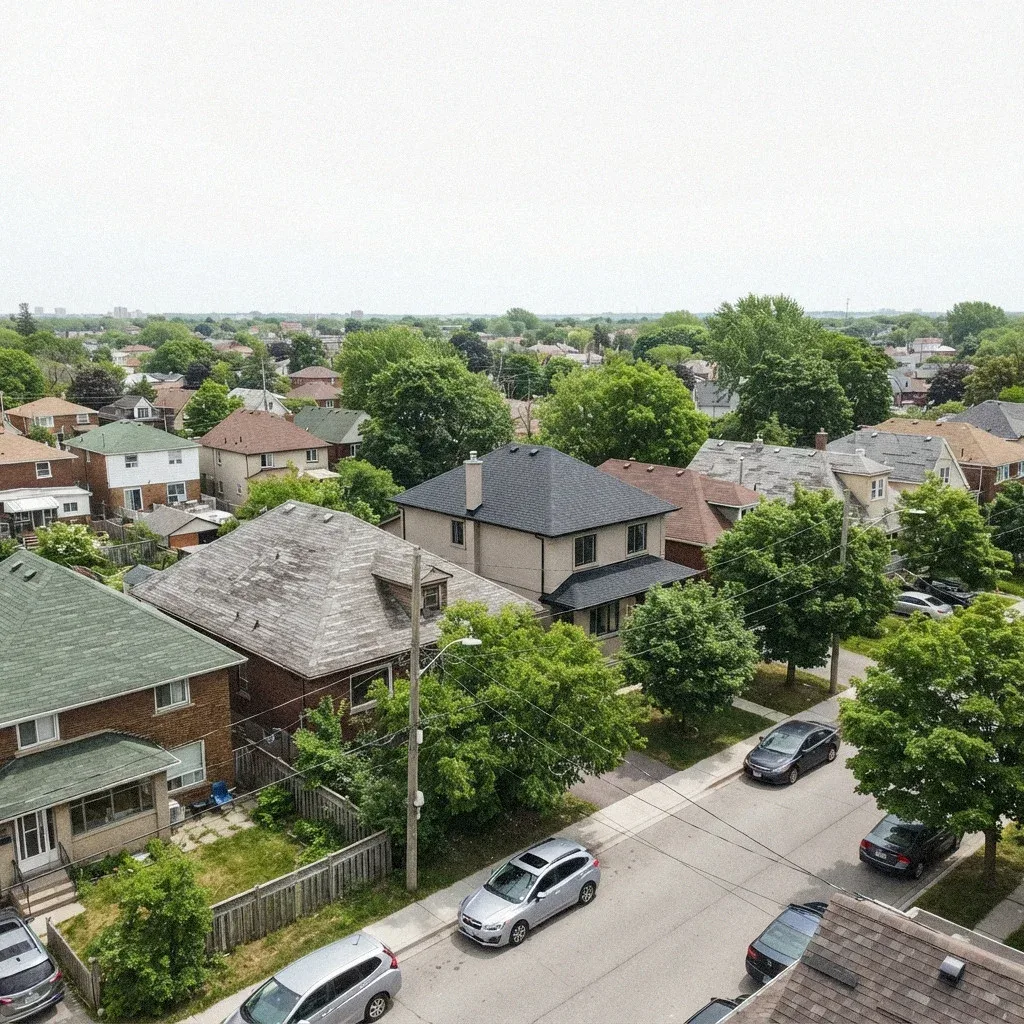
Most Jacksonville homeowners go their whole time in a house without climbing onto the roof, and a first look doesn't ask for it either. Stand where your driveway meets the street, or walk toward the sidewalk edge, and let your eyes travel each roof plane the way you'd read a paragraph. Riverside and Avondale bungalows and Cedar Hills ranch homes both give up plenty from that distance if you know where to rest your gaze.
Check the Ridge Line First
The ridge line is the top edge where two roof planes meet, and against the sky it should read as one clean, unbroken line end to end. A dip in the middle, or a wave that shows up only over one section, points to trouble in the framing or decking underneath. Homes in older Westside neighborhoods like Cedar Hills, built mostly between 1940 and 1969, are worth this ridge check simply because of their age.
Watch the Shingle Courses
Each shingle course is a horizontal row, and from the street they should stack in even, parallel bands all the way down the roof plane. A course that suddenly bows outward, or one that seems to sink lower than the rows around it, usually means something shifted underneath — settling, a soft spot, or old storm damage nobody caught. Walk the length of the house and compare courses side to side rather than staring at just one section.
Look for Cupping and Clawing
Step back until the roof plane sits at a low angle to your eye, closer to reading a fence line than staring straight up. That shallow sightline is what exposes cupping, where a shingle's center dips while the edges stay put, and clawing, where the edges lift while the middle holds flat. Both throw a shadow the midday sun erases, so a morning or late-afternoon look from the curb tells you more than noon ever will.
Spot a Bald Spot Early
A bald spot happens where the mineral coating has worn thin, leaving a smoother, darker patch showing through against the surrounding shingle. From a driveway in Riverside or Avondale, it can look almost like a shadow that never moves as the sun crosses the sky. That fixed darkness is the giveaway — a true shadow shifts through the day, but a bald patch holds its shape and position no matter the hour.
Note Streaking on North Slopes
Dark streaks running down a shaded roof plane, often the side facing away from direct afternoon sun, are typically algae rather than dirt, and Jacksonville's humidity gives it plenty to work with. Moss reads differently — it builds up as a raised, fuzzy patch rather than a streak, usually where a tree limb shades the same spot for years. Homes tucked under mature tree cover in Ortega or Avondale tend to show this pattern first.
Watch the Downspout Outlets
During one of Jacksonville's afternoon thunderstorms, watch what each downspout outlet actually does. A steady stream means the gutter run above it is clear and pitched correctly. An outlet that stays dry while rain is clearly falling somewhere else along the same gutter means a clog or a low spot is holding water back, and that standing water works against the roof edge above it long before anyone notices a leak inside.
Check Below the Soffit Line
Step back and look at the soffit and the top few rows of siding just under the roofline. A dark or rust-tinted line trailing down usually traces back to water finding a path it shouldn't, often where the gutter apron tucks under the shingle edge. On older homes around Springfield or Panama Park, this staining is worth noting even when it's faint, since it tends to spread slowly over more than one rainy season.
Look for Buildup at the Drip Edge
The drip edge runs along the roof's bottom border, and from the ground the metal itself rarely tells you much. What matters is what's piled against it. Granules washed down from higher courses often stall right there, along with pine straw or leaf litter that never made it past the gutter apron. A stretch that stays darker or holds moisture longer than the shingles above it is worth remembering for whoever looks next.
Bring Along Binoculars
A pair of binoculars from the driveway or across the street closes the gap between a hunch and something worth mentioning out loud. Shingle course lines that looked straight to the naked eye can show a slight wave once magnified. Flashing around a chimney or vent stack, blurry from thirty feet, comes into enough focus to tell rust streaks from ordinary weathering. It costs nothing and takes less time than walking the block twice.
Know What Stays Hidden
Ground-level checks are a starting point, not the full picture. A hip section facing away from the street, a low-slope area tucked behind a taller roof plane, or flashing around a chimney simply won't show from the driveway no matter how sharp your sightline is. A roof can look clean from Sunbeam Road and still hide a soft deck panel, just as a few bald spots don't always mean the underlying structure is compromised.
Get a Straight Answer
When something on that list keeps bothering you, the useful next move is narrow. Write down what you saw, which slope it was on, and what time of day the shadow showed it, then get a photograph from the same spot. Hand that to the licensed pros we connect you with and ask for two things: whether it is what you think it is, and how urgent it is. A specific question about one slope gets a specific answer. Asking somebody to tell you whether the roof is bad gets you a sales visit instead.
Dealing with this in your home?
Jacksonville roofs wear out street by street, not city-wide. Riverside and Avondale still carry crawl-space homes from the 1920s, where old decking meets modern afternoon thunderstorms. Cross the St. Johns River into Arlington and it's mostly slab homes with 1950s-60s roof lines needing different attention. San Marco's stucco bungalows near San Marco Square age differently again.