Jacksonville's humidity does not stay outside. It works its way into attic space through small gaps and vents, and once it settles there, an attic can run wetter than the house below it for months at a time. Homeowners in Riverside, Mandarin, and Arlington notice it in different ways, but the underlying problem is the same: warm, moist air is getting trapped under the roof deck with nowhere to go.
A Musty Smell On Entry
The clearest sign is smell before sight. Open the attic hatch on a Jacksonville home and a musty odor should make you stop and look closer, not shrug it off as normal heat. Sandwiched under a roof deck that bakes all day and cools fast during afternoon thunderstorms, attic air holds moisture that has nowhere to go if the space isn't breathing. That trapped dampness is what starts every other problem on this list, from Riverside bungalows to newer Mandarin construction.
Darkened Or Stained Sheathing
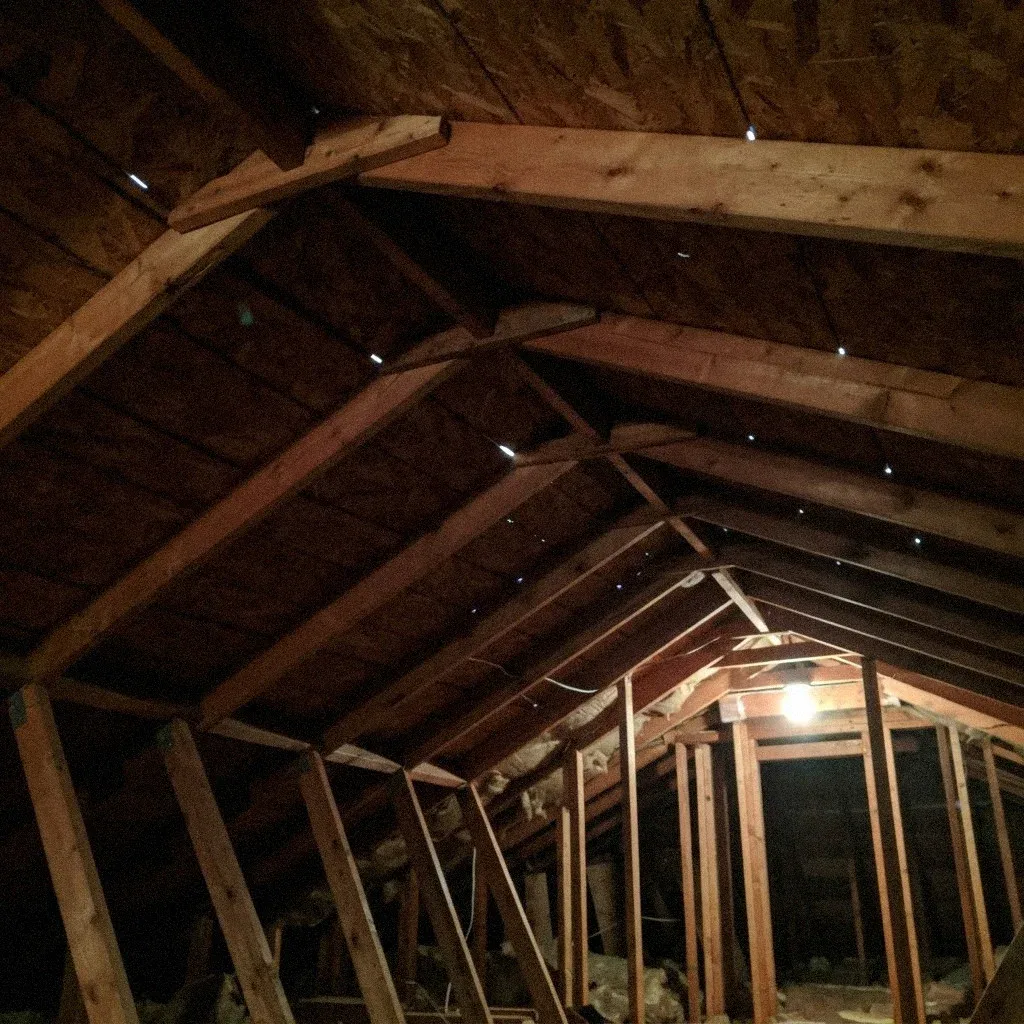
Sheathing staining shows up as gray, brown, or black patches on the underside of the roof deck, usually near the ridge or in corners where airflow is weakest. Darkened sheathing does not always mean a leak. It often means condensation has been forming and drying on the same boards repeatedly, cycle after cycle, until the wood itself starts to discolor and soften.
Rust On The Nail Shanks
Look up at the nail points coming through the underside of the deck. Those shanks are bare steel, and they are the coldest thing in the attic, so moisture condenses on them before it condenses anywhere else. A ring of orange rust around each point, or a faint rust streak running down the wood below it, means water has been forming there repeatedly rather than once. In Jacksonville this is one of the few signs that separates a humidity problem from a leak, because a leak wets a patch while condensation rusts nail points evenly across a whole slope.
Insulation That Feels Matted
Press down on the batts with a flat hand in a few places. Dry insulation springs back. Insulation that has been taking on moisture stays where you pushed it and feels heavier than it looks. The place to check first is close to the eaves, where the deck runs coldest and air movement is weakest, then the middle of a slope for comparison. Where the matting is one patch, look for a leak above it. Where it runs along an entire eave line on a Jacksonville roof, the cause is the air in the attic, not a hole in it.
Damp Boxes And Stored Items
Attics in Northside and Westside homes often double as storage, and stored items are an early warning sign homeowners overlook. Cardboard that feels soft or slightly swollen, photos that curl at the edges, or a faint dampness on holiday decorations sitting near the eaves all point to attic air holding more moisture than it should for that time of year.
Bath Fans Venting Into The Attic
Insulation that looks flattened, gray, or clumped instead of loose and fluffy has usually absorbed moisture from the air around it rather than water dripping through the roof. Matted insulation loses most of its ability to hold heat back, which is part of why upstairs rooms in older Avondale or San Marco homes can feel warmer and stickier even with the air conditioning running. Once fiberglass batts mat down from humidity, they generally need replacing rather than fluffing back up.
A Dryer Vent Ending In The Attic
A dryer vent into attic space causes a similar problem on a larger scale. Every load of laundry pushes warm, moisture-heavy air into the attic instead of outdoors, along with lint that can build up and block the path further. This is one of the more overlooked sources of attic humidity in homes across San Marco and Murray Hill.
Air Leaking Around The Hatch
The attic hatch is usually the biggest single hole between a Jacksonville house and its attic, and most of them are a sheet of plywood dropped into a frame with no seal and no insulation on top. Conditioned air goes up through the gap around it all day, and household moisture goes with it. On a humid day you can often feel the draft with the back of a hand held near the edge. Weatherstripping around the frame, a latch that pulls it tight, and a rigid insulation panel fixed to the back of the panel costs very little and removes one of the main sources.
Soffit Vents Blocked From Inside
A blocked soffit intake keeps outside air from ever reaching the attic in the first place, often because insulation has been pushed up against the eaves or a past renovation covered the opening. Without that intake air moving, humid attic air has no way to exchange with drier outside air, so it just sits and circulates in place.
What A Hygrometer Reading Tells You
A hygrometer reading gives a number to match what your nose and eyes are already telling you. Relative humidity readings that stay high in the attic, especially compared to the living space below, confirm that moisture is accumulating rather than passing through. Checking it on a few different days gives a clearer picture than a single reading.
Reading These Signs Together
None of these signs alone proves much, but a musty odor paired with matted insulation, or rusting nail shanks alongside a bath fan that vents into the attic, tells a consistent story. Jacksonville's climate makes some baseline humidity normal, so the useful question is whether several of these signs are showing up together in the same attic.
Dealing with this in your home?
Jacksonville roofs wear out street by street, not city-wide. Riverside and Avondale still carry crawl-space homes from the 1920s, where old decking meets modern afternoon thunderstorms. Cross the St. Johns River into Arlington and it's mostly slab homes with 1950s-60s roof lines needing different attention. San Marco's stucco bungalows near San Marco Square age differently again.