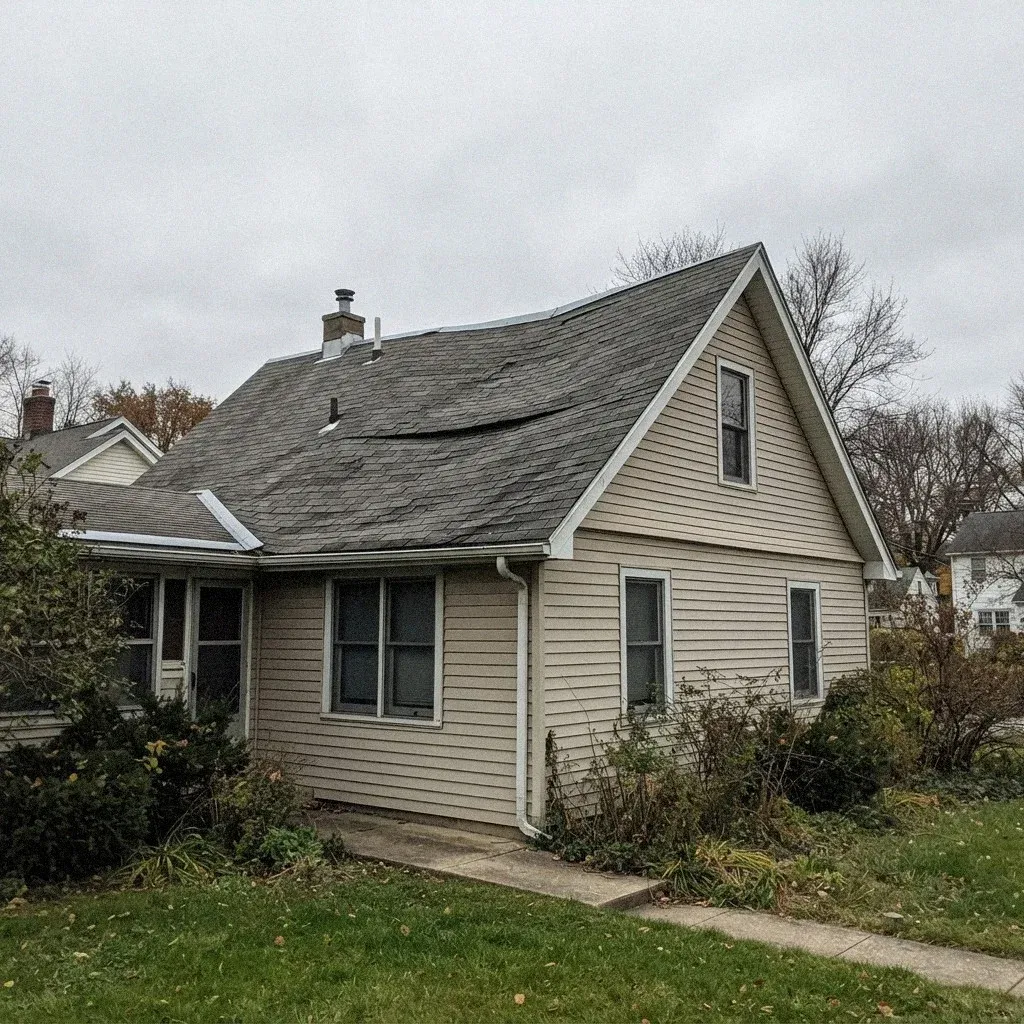
Look at a Jacksonville roofline the way you'd look at a fence line, straight down its length, not up close at the shingles. Streets in Avondale and Murray Hill carry a lot of older framing, and from the sidewalk a roof can show three distinct shapes: a bowed peak, a low patch in one section, or a plane that ripples across the whole field. Each shape points somewhere different underneath.
Ridge Sag Has a Pattern
Ridge sag shows up as a smooth bow along the very top line of the roof. Stand across the street and sight along that peak against something level behind it, a rooftop in San Marco or a straight power line will do. A ridge that curves downward in the middle usually means the load path from rafters into the ridge has weakened over years, not weeks.
A Curve, Not a Sudden Break
This kind of sag builds slowly, so it rarely looks dramatic even when it has gone on a long time. It points toward the ridge board itself, or the rafters and any collar tie meant to keep them from spreading apart. Older homes near Springfield and Riverside, framed with rafters rather than engineered trusses, are the ones where this pattern turns up most often after decades of settling.
A Dip in Just One Spot
A dip confined to one section of roof plane, rather than the whole ridge, points somewhere more local. It often sits over a single rafter that has weakened, a truss that has shifted, or a spot where roof decking has lost its stiffness from sitting wet too long. Unlike ridge sag, this pattern does not spread evenly across the house, and it can develop faster once the underlying wood starts to give.
Two Patterns, Two Places to Look
So far that is two shapes, and each sends you to a different place. A bow along the ridge means looking at framing: the ridge board, the rafters either side of it, and whether a collar tie is doing its job or was removed at some point to open up an attic. A dip inside one plane means looking at the decking and the one or two rafters under that spot. From the street the two can look similar on a Murray Hill or Springfield roof, but the first is a structural question about the whole roof and the second is usually a repair to one section.
When the Whole Plane Rolls
A wavy field reads differently again. Rather than one low spot, the entire roof plane rolls in small, repeating undulations, almost like a bedsheet pulled loosely over a mattress. Homes in Mandarin and Ortega Forest with older wood-plank sheathing under the shingles show this pattern more than homes with newer plywood decking, and it rarely lines up with just one rafter or one section of the house.
How Delamination Shows Itself
Delamination in roof decking almost never produces a single clean low point the way a broken rafter does. Instead, the plywood layers, or the boards on an older house, lose their stiffness gradually across a wide area. From the street in Baymeadows or Southside, that shows up as a loss of flatness rather than a dip you could point to with one finger, a subtle wave more than a sag.
What Purlins Suggest
Some older homes around Ortega and San Jose use purlins, horizontal supports set between the rafters and an interior wall, to help carry roof load over a longer span. A wave or dip that repeats at even intervals across the roof, rather than sitting in one place, often lines up with where those purlins meet the rafters above them, especially in houses built before trusses became standard framing.
Water Is the Common Thread
Whatever shape a sag takes, most of them in Jacksonville trace back to water more than to one overloaded moment. Afternoon thunderstorms through the summer months, humidity that never fully lets go, and the occasional hurricane season soaking all give moisture more chances to work into roof decking than a single storm ever could. Over years, that steady wetting does more to a roof plane than any one afternoon of hard rain.
Confirming a Soft Spot
A soft spot felt underfoot is how a roofer tells weakened decking apart from framing that has genuinely shifted, and it's not something to test by climbing up there yourself. Whatever gives slightly when weight is applied almost always lines up with the depression already visible from the ground, whether that's near Panama Park, Cedar Hills, or anywhere else with an older roof.
Why This Can't Wait
A visible sag doesn't fix itself, and it doesn't wait for a slow month either. Every shape described here, ridge sag, a localized dip, or a wavy field, means something under the shingles is carrying a load it wasn't built to hold, or holding water it shouldn't be. Left through another hurricane season, a small dip in a Northside or Westside home tends to become a bigger, more expensive one.
Getting It Looked At
Reading a roofline from the curb is a starting point, not a diagnosis. Confirming what's actually happening means someone checking the attic with a flashlight and someone walking the roof deck by hand, looking for give underfoot and tracing where it lines up with what's visible from the street. A homeowner in Arlington or anywhere else in Duval County who notices a shape like these has reason to get it looked at soon rather than later.
Dealing with this in your home?
Jacksonville roofs wear out street by street, not city-wide. Riverside and Avondale still carry crawl-space homes from the 1920s, where old decking meets modern afternoon thunderstorms. Cross the St. Johns River into Arlington and it's mostly slab homes with 1950s-60s roof lines needing different attention. San Marco's stucco bungalows near San Marco Square age differently again.